


Have you ever noticed how stress tightens your shoulders, anxiety knots your stomach, or joy makes your chest feel light and open?
That’s not a coincidence.
That’s the mind-body connection at work.
For many women, especially busy professionals over 30, wellness advice often feels fragmented. One expert tells you to “fix your mindset.” Another says your body needs movement or rest. But what if the real issue isn’t your thoughts or your body—what if it’s the conversation happening between them?
When stress becomes chronic, your nervous system stays stuck in survival mode. Over time, this disconnect can show up as fatigue, tension, digestive issues, emotional burnout, or a sense that your body is working against you instead of with you.
The good news?
The mind-body connection is trainable.
In this guide, you’ll learn:
- How your thoughts and body constantly communicate
- Why stress lives in the body—not just the mind
- Simple, science-backed ways to restore balance
- How to begin listening to your body with clarity instead of fear
This isn’t about perfection or “positive thinking.”
It’s about rebuilding trust between your mind and body, so healing becomes possible.
What Is the Mind-Body Connection?
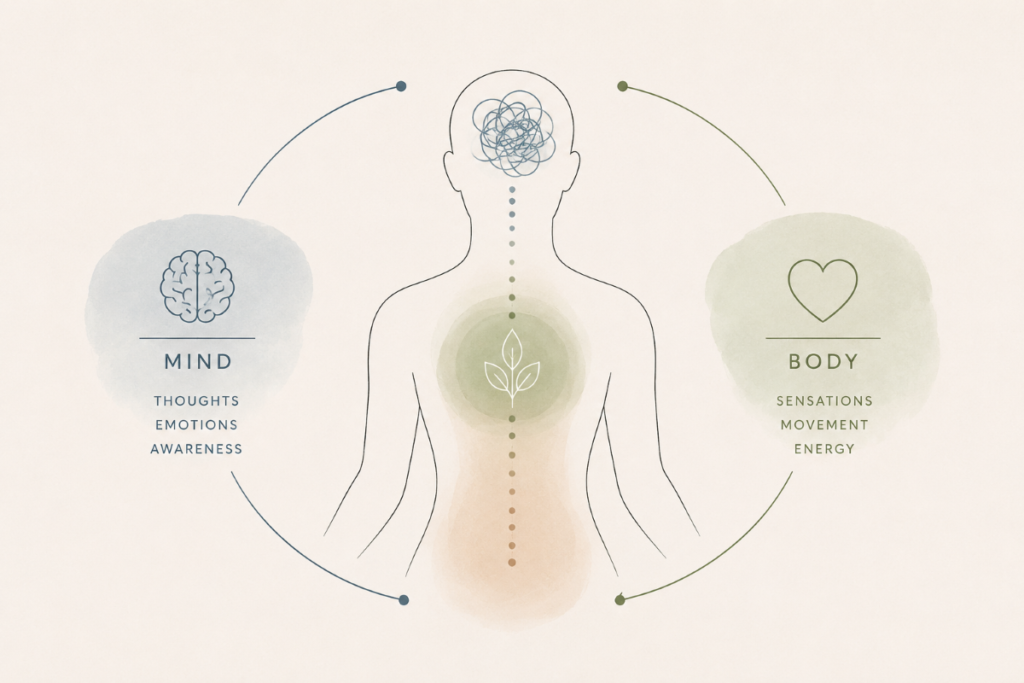
The mind-body connection refers to the continuous, two-way communication between your thoughts, emotions, nervous system, hormones, immune system, and physical body.
In other words:
- Your thoughts affect your body
- Your body affects your thoughts
This two-way relationship is the focus of mind-body medicine, an evidence-based approach to health.
This communication happens through:
- The nervous system
- Hormones like cortisol and adrenaline
- Neurotransmitters like serotonin and dopamine
- The immune and inflammatory response
When the system is balanced, you experience energy, clarity, and emotional regulation.
When it’s disrupted, the body shifts into protection.
Important truth:
Your body is not malfunctioning—it is responding.
How Stress Disrupts the Mind-Body Connection
The Survival Mode Loop
Stress activates the sympathetic nervous system—your fight, flight, or freeze response. While this response is essential in short bursts, chronic stress keeps the body stuck in alarm mode.
Over time, this can lead to:
- Muscle tension and pain
- Shallow breathing
- Digestive issues
- Hormonal imbalance
- Emotional numbness or overwhelm
The mind may think the threat is gone, but the body hasn’t received the message yet.
That’s why logical reassurance often fails.
Why “Thinking Your Way Out” Doesn’t Work
If you’ve ever tried:
- Positive affirmations
- Forcing calm
- Ignoring physical symptoms
…and felt frustrated when nothing changed, here’s why:
The body processes safety somatically, not cognitively.
Your nervous system responds to:
- Breath
- Posture
- Movement
- Sensory input
Healing must involve the body—not bypass it.
The Role of the Nervous System
Your nervous system is the control centre of the mind-body connection.
There are two key states:
- Sympathetic (stress, action, survival)
- Parasympathetic (rest, digestion, repair)
Chronic stress suppresses the parasympathetic state, limiting your body’s ability to heal.
Restoring balance isn’t about eliminating stress, it’s about teaching your body how to come back to safety.
Signs Your Mind and Body Are Out of Sync
You might be experiencing a disrupted mind-body connection if you notice:
- Feeling “wired but tired”
- Trouble relaxing even during downtime
- Chronic tension or pain with no clear cause
- Overthinking paired with physical exhaustion
- Difficulty trusting your body’s signals
These are not failures.
They’re signals asking for attention.
How to Strengthen the Mind-Body Connection (Actionable Steps)
1. Use Breath as a Reset Button

Slow, intentional breathing sends a direct signal of safety to the nervous system.
Try this:
- Inhale through the nose for 4 seconds
- Exhale slowly through the mouth for 6 seconds
- Repeat for 2–3 minutes
This activates the parasympathetic response.
2. Gentle, Trauma-Informed Movement
Movement doesn’t need to be intense to be effective.
Effective options include:
- Slow stretching
- Somatic exercises
- Walking outdoors
- Yoga focused on breath and control

Movement helps the body release stored stress without overwhelming the system.
3. Develop Body Awareness (Interoception)
Interoception is your ability to sense internal states.
Strengthen it by:
- Pausing during the day to ask, “What do I feel in my body right now?”
- Noticing sensations without judgement
- Naming sensations instead of analysing them
Awareness builds trust.
Trust creates regulation.
4. Create Safety Through Consistent Rituals
Your nervous system responds well to predictability.
Examples:
- Morning light exposure
- Regular mealtimes
- Evening wind-down routines
- Gentle stretching before bed
Small habits compound into regulation.
The Science Behind Mind-Body Healing
Research on mind-body approaches for stress suggests these practices may:
- Reduce cortisol levels
- Improve immune function
- Decrease chronic pain
- Improve emotional resilience
Mind-body therapies such as mindfulness-based stress reduction and somatic practices are now widely recognised in integrative and clinical health settings.
Frequently Asked Questions
What is the mind-body connection in simple terms?
It’s the continuous communication between your thoughts, emotions, and physical body through the nervous system and hormones.
Can the mind-body connection affect physical symptoms?
Yes. Stress and emotional states can significantly influence pain, digestion, immune response, and energy levels.
How long does it take to improve the mind-body connection?
Small improvements can be felt within weeks, especially with consistent breathwork and movement practices.
Is the mind-body connection the same as positive thinking?
No. It focuses on nervous system regulation and bodily safety rather than mental reframing alone.
Do I need special equipment?
No. Breath, awareness, and gentle movement are enough to begin.
Conclusion
Your body has never been the problem.
It has been communicating “faithfully” this whole time.
The mind-body connection reminds us that healing isn’t about pushing harder or fixing yourself. It’s about listening, responding, and restoring safety.
When your mind and body learn to communicate again, energy returns. Tension softens. Healing becomes possible.
And most importantly, you don’t feel lost in your body anymore.