

When your body has put you through a terrifying ordeal, the relationship changes. Maybe it was a sudden cardiac arrest and an implanted defibrillator. Maybe it was months of collapsing under severe burnout. Either way, your body stops feeling like a home and starts feeling like an unpredictable liability.
I know that feeling well. After my own cardiac arrest, every racing heartbeat felt like a warning, even when I was safe. If you’re wondering how to rebuild trust in your body, you’re in the right place.
Here’s the truth: it isn’t about forcing yourself back into a gym routine or thinking positively. It’s a slow, biological negotiation with your nervous system. If the fear of movement sounds familiar, start with what kinesiophobia is.
In this guide, I’ll walk you through three gentle, trauma-informed, step-by-step practices to help your body feel truly safe again, one small, manageable dose at a time.
Table of Contents
Why You Stop Trusting Your Body After Burnout or Medical Trauma
When Your Body Feels Like It Failed You
Burnout and medical trauma break trust in similar ways. Your body gives out without warning, or after warnings you pushed past. Either way, you start to see it as something that can fail you again.
You are not alone in this. The American Heart Association lists fear, anxiety, depression, and loneliness as common feelings after cardiac arrest. Research on survivors also points to hypervigilance toward bodily sensations and avoidance of exercise.
What Happens in Your Nervous System
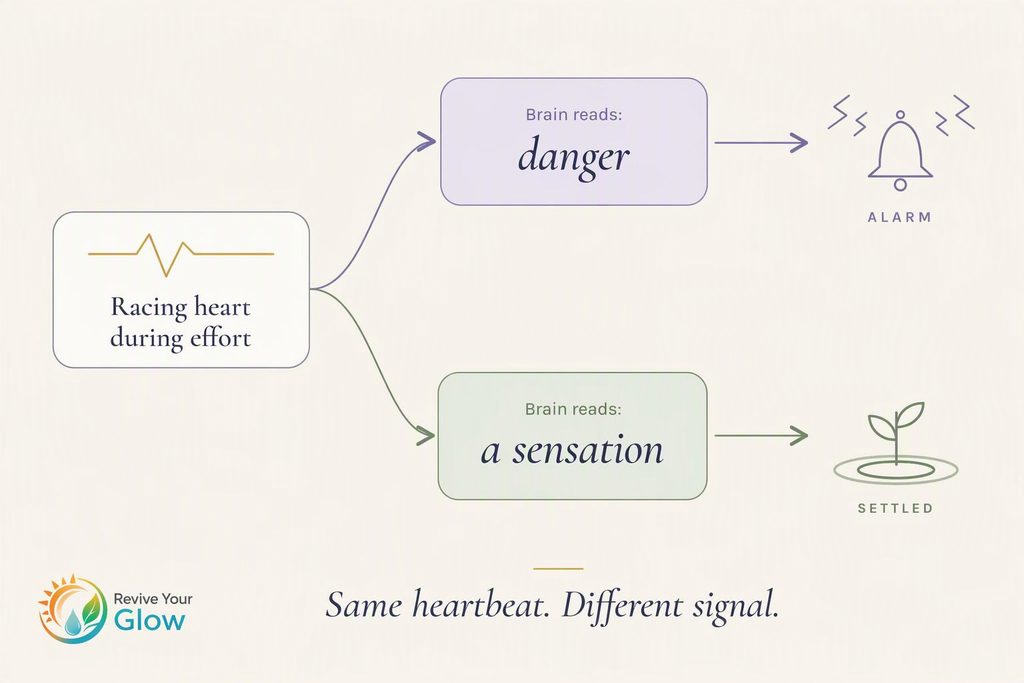
Your nervous system learns by association. If a racing heart came right before the worst moment of your life, your brain files that sensation as a threat. Burnout can do something similar: after months of overriding fatigue and tension, those signals start to feel like alarms.
Once your care team has cleared you to be active, what remains is a miscalibrated alarm, not a broken body. Exertion raises everyone’s heart rate. Your brain now reads that normal rise as the start of danger.
My Story: Why the Fear Outlasted the Danger
In April 2023, I went into cardiac arrest during a basketball game. I had an ICD implanted soon after, and I have never had an episode or a shock since.
Even so, it took me several months to start exercising. Whenever my heart rate rose, anxiety rose with it, though my body was safe. That is kinesiophobia: a fear of movement.
My nervous system was doing its job, just too loudly. The danger had passed, but the alarm had not.
My full recovery story is here. To see why movement can feel unsafe after burnout, trauma, or chronic stress, see the complete guide.
The Core Principle: How to Rebuild Trust in Your Body Starts with Safety
Trust Is Built Through Predictable Experiences
You cannot think your way into trusting a nervous system on high alert. Trust forms through repetition: small experiences that go the way you expect.
Each time you move and nothing bad happens, your brain collects evidence. The evidence builds slowly, and every bit counts.
Teach Your Brain That Movement Means Safety and Choice
Right now, your brain may hold one data set: exertion led to collapse. It needs new data: movement can be safe, and I decide when it stops.
This matters clinically. A 2024 scoping review in Frontiers in Psychology calls kinesiophobia a major obstacle to exercise-based cardiac rehabilitation. It studied people with chronic heart failure, but the pattern, fear driving avoidance, will sound familiar.
Avoidance feels protective, but it leaves the old alarm unchallenged. Gentle, chosen movement is how you challenge it.
Set Aside the Fitness Metrics for Now
Calories, heart rate zones, and step counts all push you toward performance. Set them aside for now. If your cardiologist gave you a heart rate limit, follow it. Beyond that, drop the targets.
I track energy, sleep, and calm instead. Those measures whether your body feels safe.
Regulate First, Optimize Second
Regulate first, optimize second. That is the rule I now live by.
Regulation means your body feels safe enough to try. Strength, endurance, and speed come later, and they only hold on that foundation.
This was the part I missed early in my recovery. I thought confidence would come from exercising harder. Instead, it started when I learned how to feel safe in my body before I ever challenged it.
Step 1: Somatic Grounding and Interoceptive Titration
Regulation starts before movement does. Step 1 teaches your nervous system to tolerate sensation, one small dose at a time.
What Is Titration?
Titration comes from somatic experiencing. It means exposing your nervous system to a small, manageable amount of sensation, then stopping before you tip into freeze or panic.
Try it: notice the warmth of your hands for ten seconds, then let it go. Stop there, even if it felt fine.
Practice Neutral Observation
A faster heartbeat and warm muscles are normal during effort. The problem is the story attached to them, which is also why exercise can trigger anxiety or panic symptoms.
Practice labeling sensations without a verdict: “warm,” “faster,” “tight.” Then add, this is a sensation, not a threat.
A small 2020 study of 12 healthy adults found that interoceptive training improved heartbeat-perception accuracy and lowered state anxiety. The sample is small, so treat it as an early signal.
Calm Your Body Before You Stand
Use bottom-up tools first. Start with a physiological sigh: two short inhales through the nose, then one long exhale through the mouth. A 2023 study in Cell Reports Medicine found that cyclic sighing, which repeats this breath, improved mood and lowered respiratory rate more than mindfulness meditation.
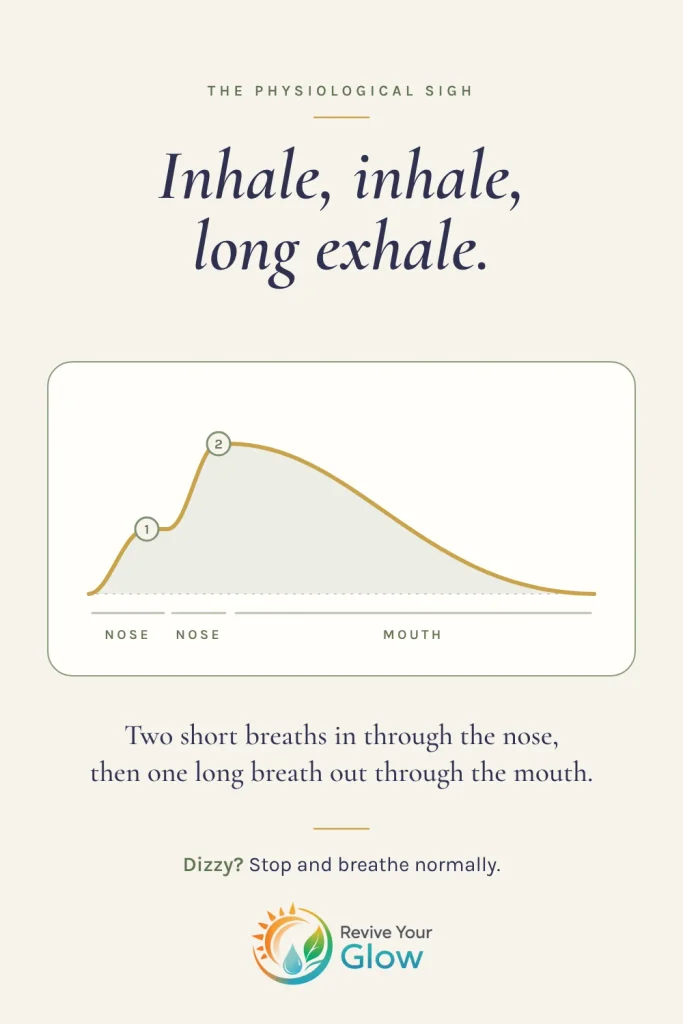
If you feel dizzy, stop and breathe normally.
Then orient slowly: look around the room and name three things you see. Feel your feet on the floor. Only then stand.
Once these feel routine, you are ready to add movement.
Step 2: Micro-Movements and Intentional Agency
Once grounding feels familiar, add movement in its smallest form. Check with your cardiologist first, since clearance comes before any change in activity.
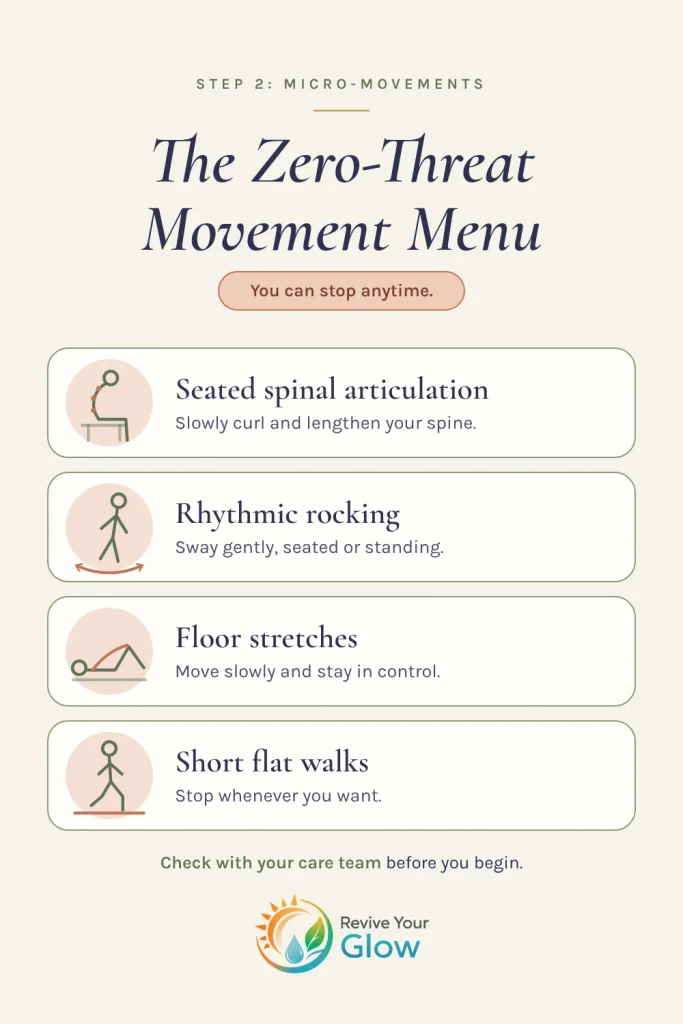
The Zero-Threat Movement Menu
Start with one of these zero-threat movements:
- Seated spinal articulation: slowly curl and lengthen your spine.
- Rhythmic rocking: sway gently, seated or standing.
- Floor stretches: move slowly and stay in control.
- Short flat walks: stop whenever you want.
Keep sessions short and choose a familiar space where you can easily sit or stop. Notice sensations as you practiced in Step 1, then end while it still feels easy.
It took me several months before I started exercising. Your timeline may differ, and that is fine. My anchor was a daily walk tied to my morning coffee, so it did not depend on motivation.
The Power of the “Out”
One of the strongest safety signals you can give a nervous system on alert is knowing you can stop at any moment. Stopping is not quitting. It is part of the practice, and it needs no explanation or self-judgment.
Each time you stop on your own terms, your brain logs one more piece of evidence: I am in control.
As movement gets easier, the next shift is in how you talk to your body.
Step 3: Rewrite the Dialogue with Your Body
Your self-talk matters because the words you use shape how you read your body’s signals.
From Adversary to Ally
Move away from “My body is failing me” and “I can’t trust my heart.” Try this instead: “My body is working overtime to protect me, and we are learning safety together.”
It does not need to feel true yet. The alarm that fires too often is protection misfiring, not betrayal.
Honor the ICD and the Trauma Shadow
Vigilance does not vanish overnight. It softens. I have had no episode and no shock since my ICD surgery, and my fear still lagged behind the facts.
Carry your ICD, or the memory of burnout, with self-compassion. Both mark what you survived, not what you failed at.
If fear stays intense or limits daily life, tell your care team. Support for anxiety and trauma is part of recovery.
Track Progress by Calm, Not Performance
Keep tracking energy, sleep, and calm. Look at the trend across weeks, not a single day. A steadier trend is a sign your nervous system is settling.
Repeat these three steps as often as you need. That repetition is how trust returns.
The Long Road Forward: Retraining Your Nervous System
Rebuilding trust in your body is a marathon of nervous system retraining, not a sprint. There is no deadline, and every small step counts.
Ground your body first. Add movement in its smallest form, with an exit always available. Then change the way you talk to your body. Each step gives your nervous system new evidence that you are safe.
Progress is not linear, and a hard day is not a setback. It is information.
As I wrote in my story, “Change doesn’t happen in one dramatic moment. It happens in the quiet, daily choices that build a life you’re proud of.”
Tell someone supportive about what you are doing and keep your care team in the loop.
To see the full picture, read why movement can feel unsafe after burnout, trauma, or chronic stress. Then start where you are, with one small step today.
FAQ
Can you rebuild trust in your body after cardiac arrest?
Many survivors do. Trust rebuilds through gradual, safe experiences, with guidance from your cardiology team and, when fear is intense, a mental health professional.
How long does it take to feel safe exercising again?
It varies by person. It took me several months just to start. Your pace depends on your medical clearance and how your nervous system responds.
Is it normal to be afraid of your own heartbeat?
Yes. Fear and heightened attention to bodily sensations are common after a cardiac event. If fear limits daily life, tell your care team.
Can you exercise with an ICD?
Many people with an ICD return to exercise. A 2024 peer-reviewed systematic review and meta-analysis found that exercise-based cardiac rehabilitation improved exercise capacity in people with implantable cardiac devices, including ICDs, without an increase in serious adverse events, but limits are individual. Your cardiologist sets your heart rate limits and activity clearance.