


Sleep and the nervous system work together to determine whether you wake up restored or exhausted. You went to bed at a reasonable hour. You slept seven, eight, maybe nine hours. And yet you woke up just as exhausted as the day before.
If that sounds familiar, you’re not alone and it isn’t simply a matter of getting more hours in bed. Restorative sleep depends on whether your nervous system feels regulated enough to let your body actually rest.
In an always-on world, deadlines, notifications, and unresolved stress can keep the nervous system in a state of vigilance long after the day ends even when your body is still. That’s why you can feel exhausted yet unable to fall asleep, wake at 3 a.m. with a racing mind, or sleep through the night and still feel depleted.
I know that experience well. For a long time, I regularly woke up between 3 and 4 a.m. feeling fully alert despite being exhausted. The frustrating part wasn’t falling asleep; it was getting back to sleep once I woke up. No matter how tired I felt, my mind often seemed unwilling to fully switch off.
The missing piece usually isn’t sleep itself. It’s nervous system regulation.
When your nervous system feels safe, your body can shift out of survival mode and into the restorative states that support deep sleep, emotional processing, and repair. When it stays activated by chronic stress, burnout, or overwhelm, quality rest becomes much harder to reach.
In our complete guide to Neurowellness, we explored how nervous system health underlies emotional resilience, energy, and focus. This article builds on that foundation, focused on one of its most important functions: restorative sleep. You’ll learn how the nervous system shapes sleep quality, why exhaustion and restoration aren’t the same thing, and how to build a nighttime routine that helps your body feel safe enough to truly rest.
💛 Gentle Medical Disclaimer
This article is for educational purposes only and isn’t medical advice. If you experience persistent insomnia, excessive daytime sleepiness, breathing difficulties during sleep, or significant disruption to daily functioning, consult a qualified healthcare professional.
Table of Contents
Why Your Nervous System Controls Sleep Quality
Sleep isn’t just something that happens because you’re tired, it’s a coordinated neurological process, and the state of your nervous system may matter more than your bedtime routine or supplement stack.
Throughout the day, your nervous system continuously asks one question: Am I safe enough to rest? When the answer is yes, your body can move into the physiological states that support deep sleep, memory consolidation, and cellular repair. When the answer is no, even without any real danger present, falling and staying asleep becomes much harder.
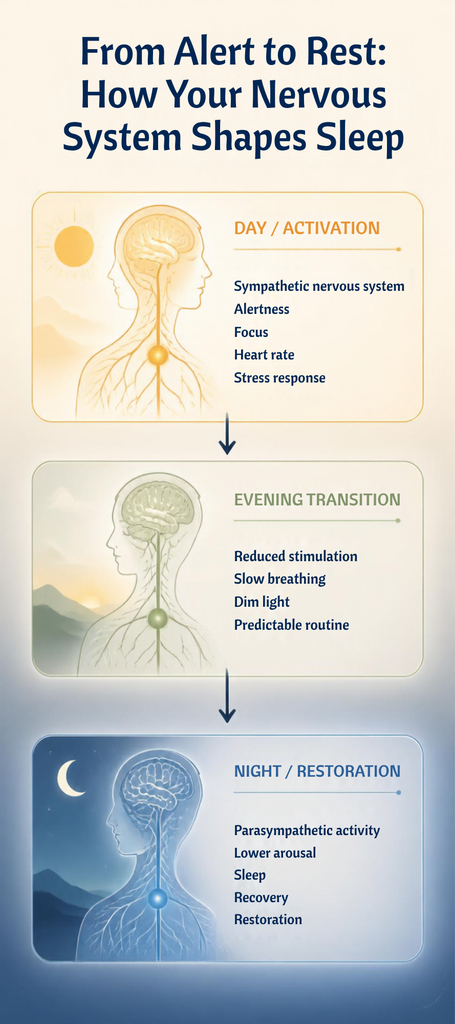
Two branches of the autonomic nervous system drive this. The sympathetic branch “fight-or-flight” raises heart rate and sharpens focus on threats: essential for survival, but not for sleep. The parasympathetic branch “rest-and-digest” slows the heart, supports digestion, and becomes more dominant as healthy sleep deepens.
The challenge is that modern life makes it hard for the nervous system to fully power down. Chronic stress, screens, irregular schedules, and constant stimulation can keep the body in hyperarousal — alert even when rest is needed. This can show up as:
- Racing thoughts at bedtime
- Frequent waking during the night
- Feeling “tired but wired”
- Waking up exhausted despite a full night’s sleep
None of this means you lack discipline. It usually means your nervous system hasn’t yet received enough signals of safety to fully let go.
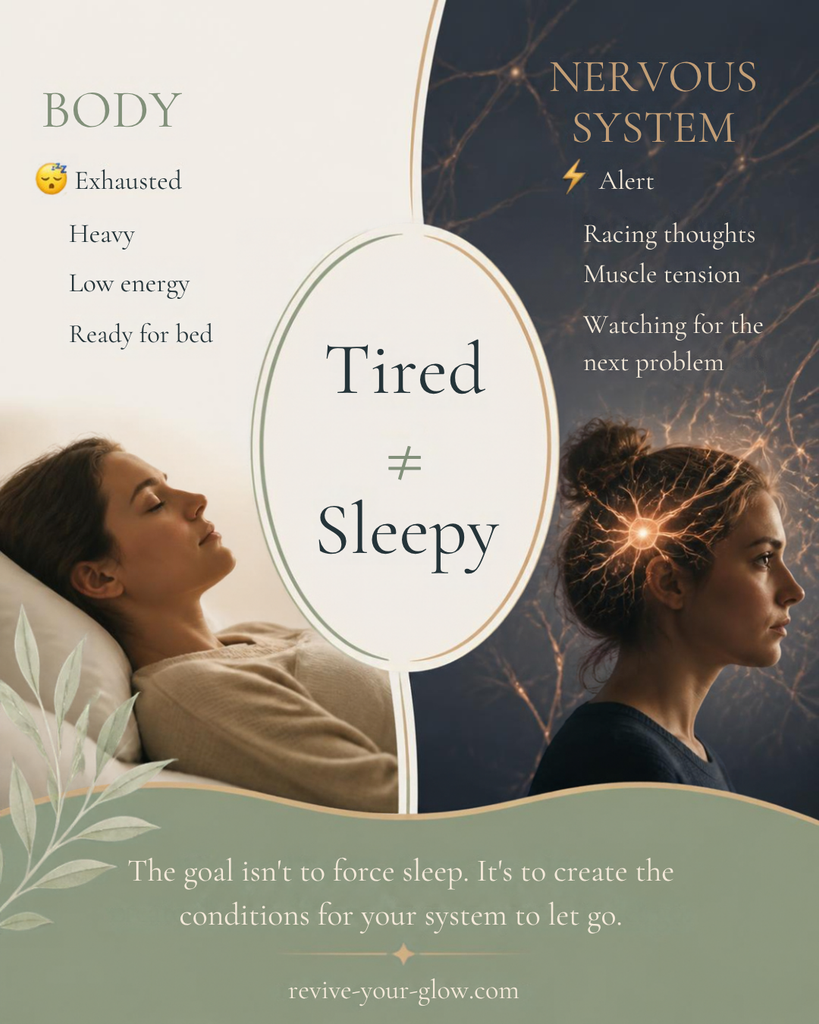
It’s also worth separating fatigue from sleepiness. Fatigue is low physical or emotional energy; sleepiness is your body’s actual drive to sleep. When the nervous system is dysregulated, the two can disconnect, you can feel deeply fatigued while still too alert to fall asleep. This is especially common during burnout recovery: your workload may have eased, but your nervous system can keep running on old survival patterns for weeks or months afterward, because recovery tends to lag behind the removal of stress.
Sleep is, at its core, an act of vulnerability, awareness drops, reaction time slows. Your nervous system places a high value on safety before allowing its deepest stages, so if it perceives unresolved stress or overstimulation, it may keep sending subtle signals that keep you partially alert. That’s not a personal failure. It’s your body protecting you with strategies built for survival, not for a demanding modern schedule.
One more myth worth naming: more hours in bed doesn’t automatically mean better recovery. The brain stays active during sleep, carrying out essential repair, memory, and immune processes which is why two people can sleep the same eight hours and wake up in completely different states. The difference is usually sleep quality and nervous system state, not just duration.
Signs Your Nervous System May Be Affecting Your Sleep
Sleep struggles often start long before bedtime. If any of these feel familiar, your nervous system may be playing a bigger role in your sleep than you’ve realized:
- Tired but wired. Your body is exhausted, but your mind races the moment you lie down — replaying conversations, previewing tomorrow.
- Can’t “switch off.” This is usually a transition problem, not a sleep problem — your nervous system needs time and intentional cues to move from productivity mode into rest.
- Waking between 2 and 4 a.m. for no obvious reason and struggling to fall back asleep.
- Waking up unrested despite seven or eight hours, because an overnight-activated nervous system limits access to deeper, restorative sleep.
- Small stressors feel bigger than they used to — more startle, irritability, or overwhelm than usual.
- Physical tension at rest — a clenched jaw, tight shoulders, a racing heart, or restless legs, even when your mind feels ready for bed.
- Relying on exhaustion, not relaxation, to fall asleep — which can produce sleep, but not always genuine restoration.
- Feeling more alive at night than during the day, when the world quiets down and the nervous system feels safer than it did during a demanding day.
None of these signs, alone or together, mean something is wrong with you. They’re information. The more useful question isn’t “Why can’t I sleep?” it’s “What does my nervous system need to feel safe enough to rest?” If this pattern feels familiar well beyond bedtime, Why You Still Feel Wired, Tired, or Numb — Even When You’re Doing Everything Right goes deeper.
What Makes Sleep Truly Restorative?
Most people measure sleep in hours. But restorative sleep is less about quantity and more about whether your brain and body can move through the processes that support real recovery, learning, memory, immune function, and emotional regulation all happen during sleep, which is why two people can sleep eight hours and wake up in completely different states.
Restoration starts with a shift from vigilance to safety. As sleep deepens, the body typically moves toward greater parasympathetic activity; lower heart rate, reduced arousal, and the recovery processes tied to deep sleep. When the nervous system stays activated, this shift becomes less efficient: you may still sleep, but your body may not fully recover.
Deep non-REM sleep does much of the physical repair, and research suggests sleep also plays a “housekeeping” role for the brain, supporting long-term neurological health. For a broader look at protecting brain function over time, see our Essential Guide to Brain Longevity for a Clearer, Stronger Future. When deep sleep is repeatedly disrupted by stress or frequent waking, the body can miss these restorative benefits even when total sleep time looks adequate, often why poor sleep affects focus, mood, and decision-making the next day.
So instead of asking “How many hours did I get?” try asking “Did my body have the conditions it needed to recover?” Restorative sleep is rarely something you force. More often, it’s something you create the conditions for.
A Restorative Night Routine
Consistency matters more than perfection here. The goal isn’t to force sleep — it’s to help your nervous system gradually shift from activity into recovery, signaling: the day is ending, it’s safe to slow down.
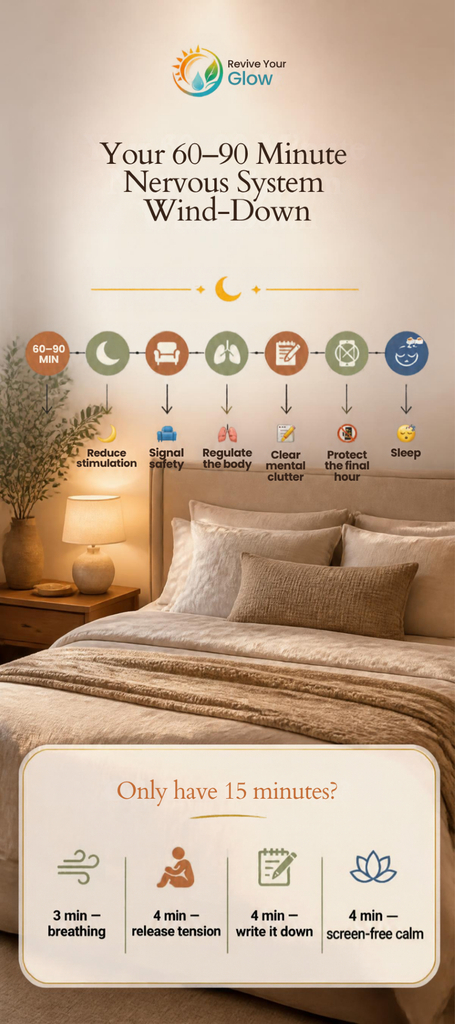
1. Reduce stimulation, 60–90 minutes before bed
Your nervous system can’t jump straight from emails or scrolling into sleep any more than your body can sprint straight into rest. Evening light exposure in particular affects circadian timing through the brain’s suprachiasmatic nucleus. Try putting work away, dimming the lights, and limiting news and social media before bed.
2. Signal safety to your body
Small, predictable rituals — a warm shower, comfortable clothes, herbal tea, a bedside lamp instead of overhead light, help the nervous system recognize the day is closing. Research in behavioral sleep medicine consistently shows that predictable pre-sleep routines reduce cognitive and physiological arousal.
3. Regulate the body before the mind
Many people try to think their way into sleep; it often works better to start with the body. A few minutes of slow breathing (in for a count of four, out for six), gentle stretching, or a brief body scan can measurably increase parasympathetic activity and ease the transition toward rest. If movement itself feels difficult or unsafe right now, that’s worth exploring on its own — see Why Movement Feels Unsafe After Burnout, Trauma, or Chronic Stress.
4. Create space to mentally unwind
Bedtime is often the first quiet moment of the day, so unfinished thoughts can surface all at once. Journaling for five minutes, writing tomorrow’s to-do list, or a brief mindfulness practice can help; research even found that writing a specific to-do list before bed helped people fall asleep faster than journaling about the day already completed.
5. Protect the final hour before bed
Treat this hour as a bridge, not a finish line — avoid checking email, doomscrolling, or watching highly stimulating content. Research on sleep and autonomic function has linked heightened physiological activation in this window to poorer sleep quality. Reading, gentle music, or simply sitting quietly reinforces the message that nothing else needs doing today.
Short on time?
Compress this into a 15-minute wind-down: 3 minutes of slow breathing, 4 minutes releasing physical tension (roll your shoulders, stretch your neck, rotate your wrists), 4 minutes writing down anything on your mind, and 4 minutes of a calming, screen-free activity.
If you wake in the night
Try not to reach for your phone. A few slow breaths, relaxing your jaw and shoulders, and reminding yourself that wakefulness isn’t an emergency can help you avoid triggering another cycle of alertness.
Even ten consistent minutes a night, repeated, teaches your nervous system that it no longer needs to stay on high alert and when it settles, sleep tends to follow more naturally. The same principle applies during the day: see Daily Glow Habits That Transform Your Energy for small, consistent habits that carry the same effect into your waking hours.
For me, progress came gradually rather than overnight. Along with improving my evening routine, I noticed better sleep quality after incorporating &mind’s AM and PM supplements, particularly Rest & Repair. My overnight awakenings became less disruptive, my stress felt more manageable, and I often woke up with better mental energy the following day. I also use the Lumières Smart Medical Device Max at home several evenings a week as part of my wind-down routine. That’s my personal experience, not a guarantee, but it reinforced an important lesson: restorative sleep rarely comes from a single solution. More often, it’s the result of consistent habits that help signal safety, recovery, and rest to the nervous system night after night.
What If I Don’t Have Time for a Full Night Routine?
One of the biggest misconceptions about better sleep is that it requires an elaborate evening routine. In reality, consistency matters far more than perfection.
If you’re thinking:
“I don’t have an hour to wind down.”
Then start with five minutes. A few slow breaths, dimming the lights, and putting your phone away earlier can still send valuable signals of safety to your nervous system.
“I’ve tried sleep routines before and they didn’t work.”
Then consider whether the goal was to force sleep rather than support it. Nervous system regulation is less about quick fixes and more about creating conditions that make restorative sleep more likely over time.
“I’m too stressed to add another thing to my to-do list.”
Then keep it simple. The best nighttime routine is the one you’ll actually repeat. Even a small habit practiced consistently can have a greater impact than an ambitious routine that lasts only a few days.
“I don’t know where to start.”
Then start with one small change tonight. Your nervous system learns through repetition, not perfection.
“What if nothing seems to help?”
Then start by giving yourself permission to stop treating sleep as a problem to solve overnight. If you’ve been stressed, burned out, overwhelmed, or sleeping poorly for months or years, your nervous system may need time to relearn what safety and rest feel like. Progress isn’t always dramatic at first. Sometimes it looks like falling asleep a little faster, waking less often, or feeling slightly more rested in the morning. Small improvements count, and they often come before bigger ones.
Common Mistakes That Keep the Nervous System Activated
A few habits quietly work against everything above:
- Going from full speed to a dead stop — expecting your body to move instantly from a busy day into deep sleep, with no buffer in between.
- Doomscrolling before bed — even positive content can be stimulating if your attention keeps switching from one thing to the next.
- Checking work email at night — a single message can trigger planning or problem-solving your brain keeps processing long after you close the app.
- Using alcohol as a sleep aid — it can help you fall asleep faster but disrupts sleep architecture, including REM sleep, leaving you more fragmented and less rested.
- Treating sleep like a performance metric — tracking, analyzing, and pressuring yourself to “fix” your sleep can itself signal the nervous system that bedtime requires effort and vigilance.
- Ignoring stress during the day — regulation isn’t only a nighttime practice; short walks, slow breathing, and breaks between tasks reduce what your nervous system carries into bed.
How Long Does Nervous System Recovery Take?
There’s no universal timeline. Recovery depends on stress levels, sleep quality, physical health, and how long your body has been operating under pressure. But it generally happens in layers.
Some shifts happen within minutes: a few minutes of slow breathing or gentle movement can measurably reduce physiological arousal. These short-term changes matter; they remind your body it’s capable of leaving a state of constant alertness.
Lasting change takes consistency. Your nervous system learns through repetition, a process made possible by neuroplasticity — the brain’s ability to reorganize based on repeated experience. Expect gradual improvements (falling asleep more easily, waking less often, recovering faster from stress) rather than overnight results, and expect the process to move in cycles rather than a straight line, a rough week doesn’t erase your progress.
Sleep is both the goal and the tool here: better regulation supports better sleep, and better sleep supports better regulation, building on itself over time. Rather than asking “How long will this take?”, a more useful question is “What am I doing today to support recovery?” a few minutes of breathing, a short walk, a consistent bedtime, less evening stimulation. Our Daily Habits for Brain Health: 12 Neurowellness Practices for a Calmer, Clearer You has more ideas. Small, daily inputs, repeated, do more than occasional big efforts.
A Quick Note
I believe in being transparent with my readers. Some links in this article are affiliate links, which means Revive Your Glow may earn a small commission if you make a purchase through them, at no additional cost to you. I only share products I personally use or would feel comfortable recommending to a friend. As always, my experiences are my own, and your results may be different.
Frequently Asked Questions
Can nervous system dysregulation affect sleep?
Yes. The autonomic nervous system helps regulate physiological arousal, heart rate, and the transition between wakefulness and sleep, and research has linked altered ANS activity to insomnia and other sleep disturbances, including persistent sympathetic activation at night.
Why am I tired but still unable to sleep?
Fatigue and sleepiness aren’t the same thing, fatigue is low physical or emotional energy, while sleepiness is your body’s actual drive to sleep. When the nervous system is dysregulated, you can feel exhausted while still too physiologically aroused to fall or stay asleep.
How do I calm my nervous system before bed?
There’s no single technique that works for everyone, but reducing evening stimulation, keeping a consistent bedtime routine, and practicing slow breathing or mindfulness are commonly recommended by sleep and behavioral health experts, and research suggests these can meaningfully influence autonomic activity.
What is restorative sleep?
According to NINDS, restorative sleep supports memory, learning, immune function, mood regulation, and communication between nerve cells. It’s measured by quality and continuity, not just total hours.
Can chronic stress affect sleep quality?
Yes. Chronic stress raises physiological arousal, which can interfere with both falling asleep and staying asleep, and research has linked stress-related autonomic activation to poorer sleep quality overall. Beyond sleep, sustained stress and high cortisol are also linked to changes in memory-related brain regions, which we cover in our guide to cortisol and cognitive reserve.
How long does it take to regulate the nervous system?
There’s no evidence-based universal timeline, regulation depends on sleep quality, health status, stress levels, and daily habits. Some relaxation techniques produce short-term changes in minutes, while lasting adaptation generally develops through consistent practice.
Can anxiety interfere with sleep?
Yes. Anxiety is commonly associated with increased cognitive and physiological arousal, racing thoughts, muscle tension, heightened alertness, all of which can make it harder to fall or stay asleep.
Is waking up at 3 a.m. a sign of nervous system dysregulation?
Not necessarily. Night waking is common and can stem from stress, environmental disturbances, medication effects, or normal variation in sleep architecture, there’s no evidence that a specific wake time alone indicates dysregulation.
What’s the difference between sleep and nervous system recovery?
Sleep is a physiological state that occurs throughout the night, while nervous system recovery is the broader restoration of healthy balance, also shaped by physical activity, stress management, and social connection.
What’s one of the most important habits for better sleep?
According to NINDS, maintaining a consistent sleep schedule helps support the circadian rhythms that regulate sleep and wakefulness.
Final Thoughts: Sleep Begins Long Before Bedtime
If you’ve struggled with sleep, it’s easy to assume something is wrong with you, a lack of discipline, the wrong supplement, the wrong routine. But your nervous system may simply be doing exactly what it was built to do: stay alert when life feels demanding, even once you’re physically ready to rest.
That’s actually freeing. It means you can work with your body instead of against it, reducing stimulation before bed, building small rhythms that support recovery, and giving yourself permission to slow down.
Start with one small change: one slower breath, one less distraction, one intentional moment of calm. Repeated consistently, those small signals become a powerful message to your nervous system and that message can change the way you sleep.
If you’d like to explore the bigger picture of nervous system regulation, read our Neurowellness Guide, where we cover how brain health, emotional resilience, stress recovery, movement, and sleep all work together.




Very informative….. Thanks
Thank you so much, I’m glad it was helpful. If you’re exploring more gentle wellness guidance, you might also enjoy this one: https://www.revive-your-glow.com/7-daily-habits-of-women-who-age-well/.