


Brain Longevity became the unexpected theme of our June visit to the Biohackers World Conference & Expo in New York City. Joanne and I walked in with practitioner passes and one goal: talk to the people building the science of longevity, not the people just marketing it.
We expected supplement pitches, wearable demos, and a lot of cold plunge talk. We got all of that. But the conversation that changed how I think about aging happened at a booth focused on something narrower than “longevity” in general — the brain.
At the &Mind booth, I asked their Chief Scientist, Dr. John-Paul Andersen, what drew him to brain health specifically, out of every field he could have chosen. His answer wasn’t professional first, it was personal. Several people in his family have dealt with cognitive decline and early signs of dementia. Watching that up close is what pushed him to spend his career studying how nutrition, cellular metabolism, and neurotransmitter balance shape long-term brain health.
That distinction stuck with me. He wasn’t researching brain health as an abstract wellness trend. He was researching it because he’d watched what happens when a brain doesn’t get the support it needs, in people he loves.
That conversation reframed a question I hadn’t thought to ask before: not “how do I stay sharp,” but “when does the decline I’m trying to prevent actually start?”
Most people think cognitive aging is a problem for their 60s and 70s. It isn’t. A long-running University of Virginia study found that measurable decline in processing speed, reasoning, and visual puzzle-solving can begin in your late 20s, with memory following by the late 30s. That gap, between when people start worrying about brain health and when their brain actually needs attention, is the reason this guide exists.
This isn’t a supplement pitch. It’s the foundational piece for everything we’ll publish in RYG’s Brain Health hub — the article we’ll keep linking back to as we cover brain fog, mental fatigue, and the daily habits that protect cognition long before memory lapses show up.
Here’s what we’ll cover
If you’ve ever walked into a room and forgotten why or lost your train of thought mid-sentence and blamed it on being busy, this guide is for you — whatever your age, whatever your gender, wherever you’re starting from.
What Is Brain Longevity?
Defining Brain Longevity (and How It Differs From “Brain Health”)
“Brain health” describes a snapshot: how well your brain is functioning right now. The National Institute on Aging breaks that snapshot into several areas; cognitive function (thinking, learning, remembering), motor function, emotional function, and sensory function.
Brain longevity is different. It’s not a snapshot — it’s the trend line. It’s the deliberate, ongoing practice of protecting those functions over decades, so the snapshot still looks good at 60, 70, and beyond.
Think of it this way:
- Brain health asks: “How is my brain doing today?”
- Brain longevity asks: “What am I doing today that determines how my brain will be doing in twenty years?”
The Pillars of Brain Longevity: Structure, Function, and Resilience
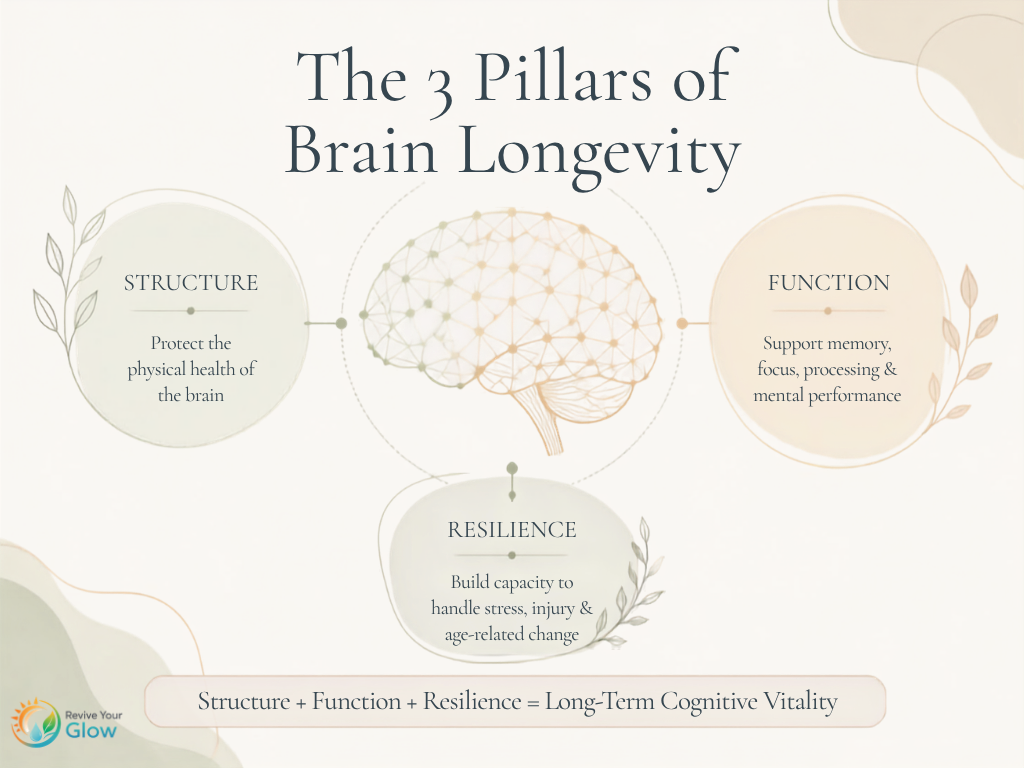
Brain longevity rests on three things working together:
- Structure — the physical brain itself: blood flow, neuron health, the connections between brain cells
- Function — how well that structure translates into thinking, memory, focus, and emotional regulation day to day
- Resilience — your brain’s capacity to absorb stress, injury, or age-related change without losing function
That third pillar, resilience, is the one most people never think about until they need it. We’ll come back to it later in this guide under its research name: cognitive reserve.
Why Brain Longevity Is a Long-Game Strategy, Not a Quick Fix
There’s no single supplement, biohack, or morning routine that “solves” brain longevity. It’s built from small, repeated choices, the kind that don’t feel dramatic at the moment but compound significantly over years.
That’s also why timing matters more than most people realize, which brings us to the next question.
Why Does Cognitive Aging Begin Earlier Than Most People Think?
The Cognitive Aging Curve: What Actually Happens in Your 30s and 40s
We already touched on this in the introduction, but it’s worth sitting with; processing speed, reasoning, and spatial problem-solving tend to peak around age 22 and begin a slow decline by the late 20s. Memory tends to hold steady longer, showing measurable decline by the late 30s.
None of this means you’re “losing your mind” in your 30s. It means the brain ages gradually and continuously, not suddenly at some later milestone. Vocabulary and accumulated knowledge, for what it’s worth, keep improving well into your 60s, the decline is domain-specific, not global.
Common Myths About When Brain Decline “Starts”
A few beliefs get in the way of early action:
- “Cognitive decline is a senior citizen problem.” It isn’t, the earliest measurable changes show up decades before retirement.
- “If I don’t have memory problems, my brain is fine.” Processing speed and reasoning can decline before memory does.
- “There’s nothing I can do until it becomes a real problem.” Prevention works best long before symptoms appear, not after.
Early Signals Most People Dismiss as Stress or Busyness
Midlife brings a specific, often-overlooked risk factor: blood pressure. Decades of research have found that having high blood pressure between your 40s and early 60s raises the risk of cognitive decline later on. One large clinical trial even found that adults 50 and older who brought their systolic blood pressure below 120 mmHg reduced their risk of developing mild cognitive impairment.
A number on a blood pressure cuff in your 40s is also a brain longevity number. It’s worth tracking, not just for your heart.
Brain Health vs. Mental Health: Why the Distinction Matters
What Brain Health Actually Measures
Brain health is physiological. It’s about how well the organ itself is functioning; cognition, motor control, sensory processing, and emotional regulation as a biological function of brain circuitry.
What Mental Health Actually Measures
Mental health is broader and more experiential. It’s your emotional, psychological, and social well-being, how you cope with stress, relate to others, and handle the ordinary difficulty of being a person.
You can have good brain health and still struggle with mental health, and vice versa. A brain can be structurally and cognitively sound while someone experiences anxiety or burnout. The reverse is also true.
Where the Two Overlap — and Why Longevity Strategies Need Both
The overlap is significant: chronic stress affects brain structure over time, and conditions like depression have been linked to higher dementia risk later in life. This is why a brain longevity strategy that only addresses supplements or diet, while ignoring stress and emotional regulation, is incomplete by design.
If you take one thing from this section: brain longevity work has to include both what you feed your brain and what you ask your nervous system to carry.

Mental Fatigue vs. Physical Fatigue: Learning to Tell Them Apart
What Mental Fatigue Feels Like (and Where It Comes From)
Mental fatigue is a real, measurable state that builds after sustained cognitive demand, a long stretch of focused work, decision-making, or emotional labor. It shows up as reduced motivation, slower thinking, and a strong urge to disengage from anything requiring more concentration.
What Physical Fatigue Feels Like (and Where It Comes From)
Physical fatigue comes from the body: muscle exertion, poor sleep, illness, or simply not enough rest. It’s driven by different biological mechanisms than mental fatigue, energy metabolism and muscle recovery, not cognitive load.
Interestingly, research shows the two aren’t fully separate. Studies using cognitively demanding tasks have found that mental fatigue can reduce physical endurance afterward, not by weakening the muscles themselves, but by making physical effort feel harder than it actually is.
Why Misreading One as the Other Delays the Right Recovery Strategy
This is where people get stuck. If you’re mentally fatigued and respond with more physical activity alone, you may feel some relief, but you haven’t addressed the actual source. If you’re physically fatigued and try to power through with caffeine and willpower, you’re treating a body problem like a mind problem.
- Mentally fatigued: needs cognitive rest, a change in task type, or a break from decision-making
- Physically fatigued: needs sleep, recovery, and reduced physical demand
- Both at once: needs both — and often, that combination is a sign to look at your whole routine, not just push through
Brain Fog and Cognitive Performance: The Symptom You Can’t Ignore
What Brain Fog Actually Is (and What It Isn’t)
Brain fog isn’t a medical diagnosis. It’s a real, well-recognized cluster of symptoms that affects how clearly you think, focus, and remember; difficulty concentrating, forgetfulness, losing your train of thought, and a general sense of mental cloudiness.
Root Causes Behind Brain Fog After 40
Brain fog has multiple possible causes, and it’s rarely just one thing:
- Poor or insufficient sleep
- Chronic stress and elevated stress hormones
- Hormonal shifts (more on this in the next section)
- Nutrient deficiencies
- Underlying inflammation
- Certain medications and their side effects
- Illness or infection, including some effects seen after viral illness
Because the causes vary so widely, persistent brain fog is worth mentioning to a healthcare provider — not to alarm you, but because identifying the actual cause is what makes it treatable.
How Brain Fog Quietly Erodes Focus, Memory, and Decision-Making
The frustrating part of brain fog is how it compounds. Missed details at work lead to more time double-checking things. Forgotten words in conversation lead to more mental effort spent searching for them. None of it feels dramatic day to day, but it adds friction to almost everything you do, which is exactly why addressing the root cause matters more than pushing through it.
How to Build Your Daily Brain Health Routine
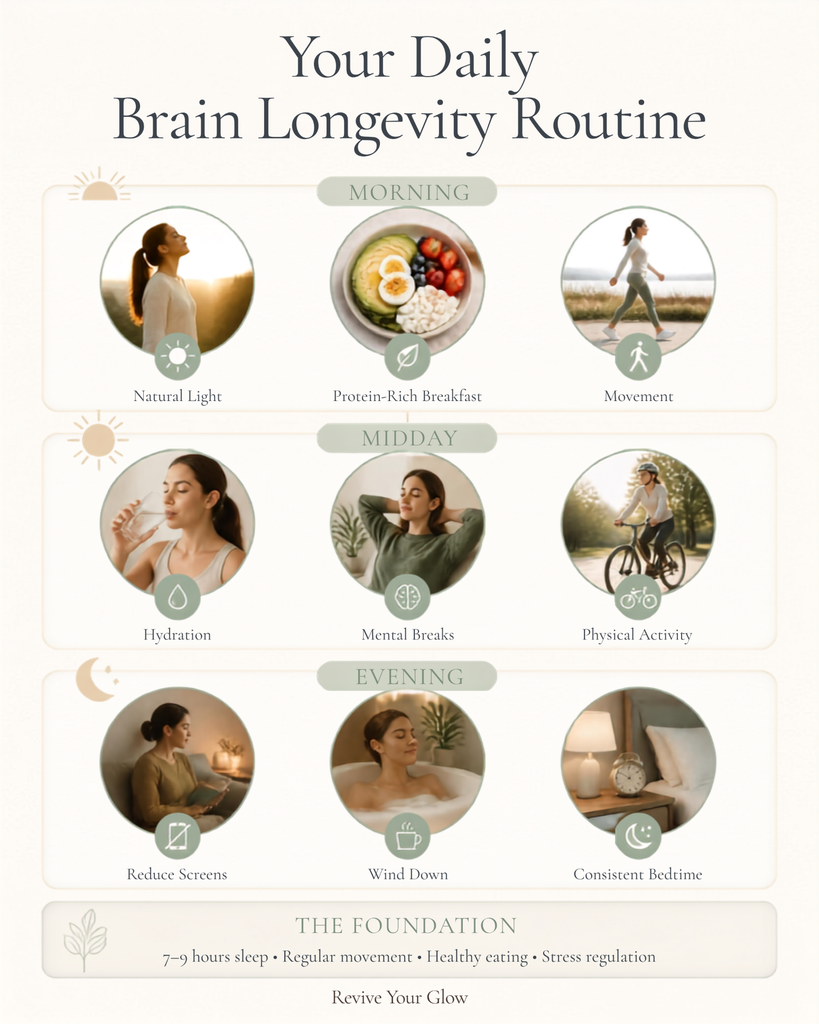
There’s no universal supplement stack or app that replaces the basics. The interventions with the most consistent research support are the least flashy ones: movement, nutrition, sleep, cognitive engagement, and social connection.
Morning: Priming the Brain for Focus and Clarity
- Get natural light exposure early — it supports your circadian rhythm, which in turn affects sleep quality that night
- Prioritize protein and stable blood sugar at breakfast rather than a sugar spike that leads to a mid-morning crash
- Move your body, even briefly — a walk counts
Consistent morning routines can also reduce decision fatigue and create a more predictable rhythm for the nervous system, which is why many people find that simple morning glow rituals make it easier to sustain energy, focus, and healthy habits throughout the day.
Midday: Sustaining Mental Energy Without the Crash
- Stay ahead of hydration and blood sugar dips, both of which affect focus and reaction time
- Break up long stretches of concentrated work; cognitive fatigue builds with sustained demand, as covered above
- If you’re going to be physically active, midday activity counts toward the 150 minutes per week of physical activity associated with better cognitive outcomes
Evening: Supporting Recovery and Memory Consolidation
- Wind down with reduced screen exposure before bed to support sleep onset
- Keep a consistent bedtime — sleep is when the brain does much of its restorative and memory-consolidating work
- Avoid using alcohol as a sleep aid; it disrupts the sleep architecture your brain needs for real recovery
To help your nervous system settle first, see our guide to better sleep and recovery.
Foundational Habits: Sleep, Movement, Nutrition, and Stress Regulation
- Sleep: aim for 7–9 hours consistently
- Movement: regular physical activity is one of the most consistently supported interventions for cognitive health
- Nutrition: a diet built around vegetables, whole grains, lean proteins, and healthy fats supports brain function. Rather than focusing on any one branded eating plan, the evidence consistently points toward long-term adherence to healthy dietary habits as the most important factor for cognitive health
- Stress regulation: chronic stress affects both brain health and mental health, which is why this isn’t optional; it’s foundational
This is where RYG’s “regulate first, optimize second” philosophy applies directly to the brain: a nervous system under constant stress will not get the full benefit of a good diet or a good supplement. Calm has to come before optimization.
Long-Term Cognitive Vitality: Thinking Beyond Today
Building a Brain-Longevity Mindset for the Decades Ahead
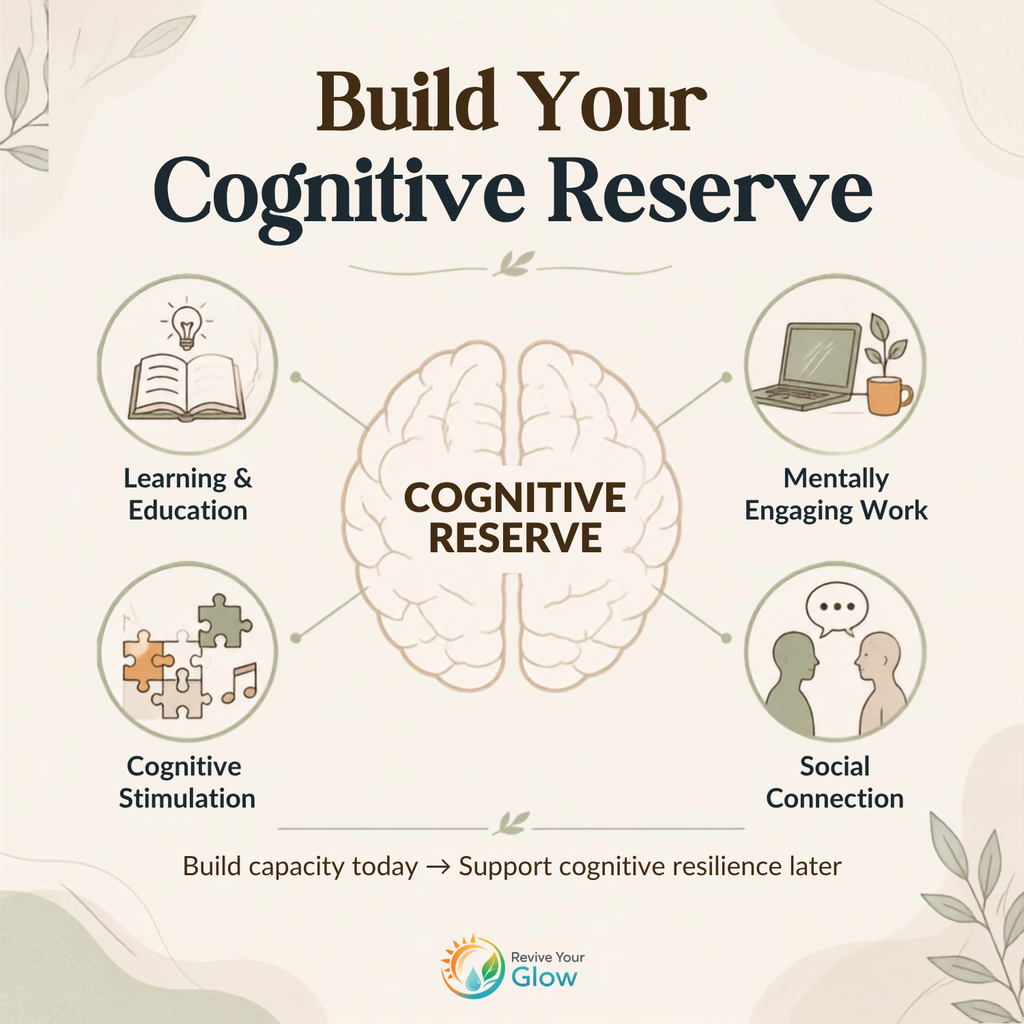
Researchers use a specific term for the brain’s ability to keep functioning well despite age-related change: cognitive reserve. The concept, developed through decades of research including the work of neuropsychologist Yaakov Stern, helps explain why some people maintain cognitive function despite age-related brain changes. Cognitive reserve is thought to be built over a lifetime through education, mentally engaging work, and ongoing cognitively stimulating activity.
Cognitive reserve is thought to be built over a lifetime, through education, mentally engaging work, and ongoing cognitively stimulating activity. The takeaway: brain longevity isn’t just about slowing damage. It’s about actively building capacity that protects you later.
Tracking Progress Without Obsessing Over Perfection
Brain longevity is not a scoreboard. There’s no single number to hit. A more useful approach:
- Notice trends over months, not days
- Pay attention to functional changes — are daily tasks getting harder, not just “do I feel sharp today”
- Treat setbacks (a bad sleep week, a stressful month) as normal, not evidence you’re failing
This long-view approach mirrors many of the daily habits of women who age well, where long-term consistency matters far more than short-term perfection.
When It’s Time to Loop in a Healthcare Professional
Occasional forgetfulness is a normal part of aging. The distinction worth watching for is a change that’s sudden, progressive, or that interferes with daily functioning; forgetting how to do familiar tasks, getting lost in familiar places, or repeated difficulty following conversations. Those are reasons to talk to a doctor, not reasons to self-diagnose from an article.
Brain Longevity Is for Everyone
Why Cognitive Care Shouldn’t Be Gendered
Brain longevity content often gets marketed at one demographic, usually women managing menopause-related symptoms. That’s a real and legitimate need, but it leaves out half the population dealing with their own, less-discussed version of the same problem.
Shared Risk Factors, Shared Solutions
Hormonal shifts affect cognition in both sexes, just differently:
- In women, fluctuating estrogen during perimenopause has been linked to temporary difficulties with verbal memory and learning, largely resolving after hormone levels stabilize post-menopause.
- In men, testosterone declines gradually with age (sometimes called andropause), and lower levels have been associated with higher rates of cognitive decline in observational studies, though clinical trials on testosterone treatment for cognition have shown inconsistent results, so this connection is still being studied.
What matters more than the hormone involved is the shared foundation underneath it: cardiovascular health, blood sugar regulation, sleep quality, and stress management protect cognitive function regardless of gender. Those are the levers everyone can pull, starting today.
Frequently Asked Questions
At What Age Does Cognitive Decline Actually Start?
Research suggests some cognitive skills, like processing speed and abstract reasoning can begin a slow decline in your late 20s, with memory following by the late 30s. This doesn’t mean you’re declining rapidly at 28, the changes are subtle and highly individual. Vocabulary and accumulated knowledge, by contrast, keep improving well into your 60s.
Is Occasional Forgetfulness Normal, or a Sign of Dementia?
Occasional forgetfulness; misplacing your keys, blanking on a name, is a normal part of aging, not a symptom of dementia. The distinction that matters is whether a change is sudden, progressive, or interferes with daily life; forgetting how to do familiar tasks or getting lost somewhere familiar. If that’s what you’re noticing, talk to a healthcare provider rather than searching for reassurance online.
Can Brain Longevity Actually Be Improved, or Is Decline Inevitable?
Some degree of age-related change is normal, but how much it affects you isn’t fixed. Researchers use the term “cognitive reserve” to describe the brain’s built-up capacity to keep functioning well despite age-related changes. That reserve is something you build over time, through education, mentally engaging work, and staying cognitively and socially active, the same habits covered earlier in this guide.
Does Stress Really Affect Brain Health as Much as Diet or Exercise?
Yes — and it’s often the most overlooked piece. Chronic stress keeps the nervous system in a heightened state that can affect memory, focus, and emotional regulation over time. A brain longevity routine that addresses food and exercise while ignoring stress is incomplete. That’s why regulating the nervous system belongs at the foundation of a routine, not as an afterthought.
Do Brain Health Supplements Actually Work?
The honest answer: evidence is mixed, and it depends heavily on the specific ingredient, dose, and person. The National Institute on Aging doesn’t currently recommend any vitamin or supplement specifically for preventing Alzheimer’s or cognitive decline, though some recent clinical trials have shown a daily multivitamin may modestly improve memory in older adults. Supplements are best treated as potential support for a solid foundation, not a replacement for sleep, movement, nutrition, and stress regulation.
How Much Exercise Do I Actually Need to Protect My Brain?
Federal guidelines recommend at least 150 minutes (2.5 hours) of moderate physical activity per week for adults, and that same amount has been linked to better cognitive outcomes in NIH-supported research. You don’t need an intense training program; brisk walking, cycling, or swimming spread across the week counts. Consistency matters more than intensity.

Living Longer, Thinking Clearer, Aging Intelligently — The RYG Approach
How Revive Your Glow Approaches Brain Longevity
We didn’t come to this topic from a marketing meeting. We came to it from a conference floor conversation with a scientist whose own family history made brain health personal, and from a growing list of research that says the window for protecting cognitive performance opens far earlier than most people assume.
Our approach starts with regulation, not optimization. A stressed, sleep-deprived nervous system won’t get the full benefit of any diet, supplement, or routine. Once that foundation is in place, the daily habits in this guide compound over years, not days.
Your Next Step Toward Sharper, Longer-Lasting Cognitive Health
This article is the foundation for everything we’ll publish next in RYG’s Brain Health hub — the deeper dives into sleep architecture, stress regulation, nutrition for cognitive function, and the specific products we’ve personally tested for this purpose. Consider this your starting point, not your finish line.