


Sleep architecture is the pattern of sleep stages your brain cycles through about every 90 minutes each night. Deep (slow-wave) sleep, concentrated early in the night, helps move new facts and events into long-term memory and appears to support the brain’s waste-clearance system. REM sleep, which lengthens toward morning, supports procedural and emotional memory. Both tend to get lighter and more fragmented after 40, which is why which stages you get matters as much as how many hours.
You already know sleep matters. What most advice leaves out is that it’s not just about how many hours you get; it’s about which specific stages you’re actually getting, and what your brain does with them once you’re out.
One morning after a restless night, I was reviewing the day’s schedule before driving a senior diplomat to a series of meetings. Despite looking at the itinerary several times, I found myself repeatedly checking addresses and pickup times because the details simply wouldn’t stick. Later that evening, when I sat down to write an article, I caught myself reading the same paragraph over and over without absorbing it. It wasn’t that I felt extremely tired. What surprised me most was how poor sleep seemed to dull my memory and mental sharpness throughout the entire day.
That moment is the same process this article is about. While you sleep, whether you remember it or not, your brain runs a structured, staged process filing away what you learned that day and clearing out the biological waste tied to long-term cognitive decline. Skipping or shortening the wrong stage doesn’t just cost you energy the next morning. Over time, it costs you something more specific.
This isn’t about chasing more hours in bed. It’s about understanding sleep architecture: what it is, what it does for your memory, and why it matters more, not less, after 40.
💛 Gentle Medical Disclaimer This article is for educational purposes only and isn’t medical advice. If you have concerns about memory changes, cognitive decline, or a sleep disorder, consult a qualified healthcare professional.
Table of Contents
What Is Sleep Architecture?
Sleep isn’t a single, uniform state; it’s a structured cycle your brain moves through several times each night, known as sleep architecture. Across roughly 90-minute cycles, you pass through stages of increasingly deep non-REM (NREM) sleep, then briefly into REM (rapid eye movement) sleep, before the cycle starts again.
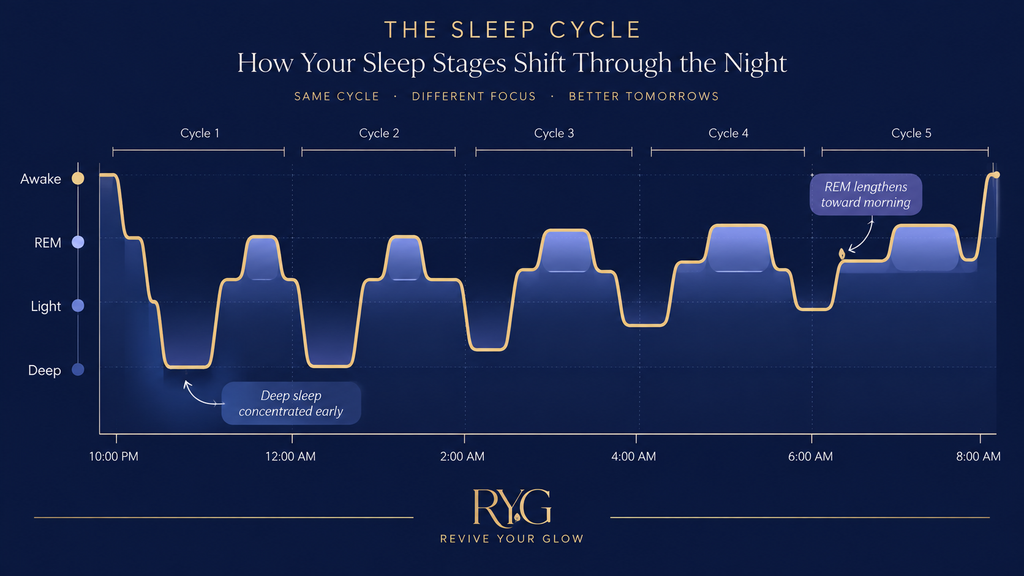
Each stage does different work. The first two NREM stages are lighter, transitional sleep, your body slows down, but you’re still easy to wake. The third stage, often called slow-wave or deep sleep, is where most physical repair happens and, as the next section covers, where a large share of memory processing happens too. REM sleep, by contrast, is when the brain becomes almost as active as it is while awake. It’s when most vivid dreaming occurs, and it plays its own distinct role in memory and emotional processing. overview of sleep basics breaks each stage down in more detail.
One detail matter more than people realizes: these stages aren’t spread evenly across the night. Deep, slow-wave sleep is concentrated in the first half; REM periods lengthen as morning approaches. That’s part of why cutting a night short doesn’t cost you sleep “evenly”: waking early takes a disproportionate bite out of REM, while deep sleep, being front-loaded, is relatively protected.
Which stage you lose, not just how many hours is exactly why the next two sections matter.
Here’s how the four stages compare:
| Stage | Typical share of the night* | When it dominates | What it does for your brain |
|---|---|---|---|
| NREM 1 (light) | ~5% | Falling asleep; start of each cycle | Brief transition into sleep; easy to wake from |
| NREM 2 (light) | ~45–55% | Throughout the night, more in later cycles | Stabilizes sleep as you move toward deeper stages |
| NREM 3 (deep, slow-wave) | ~15–25%, less with age | First half of the night | Consolidates facts and events; physical repair; peak waste clearance in animal studies |
| REM | ~20–25% | Lengthens toward morning | Procedural and emotional memory; most vivid dreaming |
How Your Brain Files Memories While You Sleep
Learning something new doesn’t finish the moment you learn it. The memory still needs to be stored somewhere lasting, and most of that work happens overnight.
Two brain regions handle this. The hippocampus holds new information right after you learn it, but that storage isn’t permanent, more of a holding area than a filing cabinet. The neocortex is where memories eventually settle for the long term.
During slow-wave sleep, these two regions have a kind of conversation. Bursts of activity in the hippocampus replay the day’s new information, and the neocortex reactivates alongside it. Repeated enough times, over enough nights, this moves the memory out of that fragile holding area and into stable, long-term storage. Researchers at the University of Tübingen showed this directly: in people who slept after learning, new memories became stable and no longer depended on the hippocampus, while people who stayed awake kept relying on it.
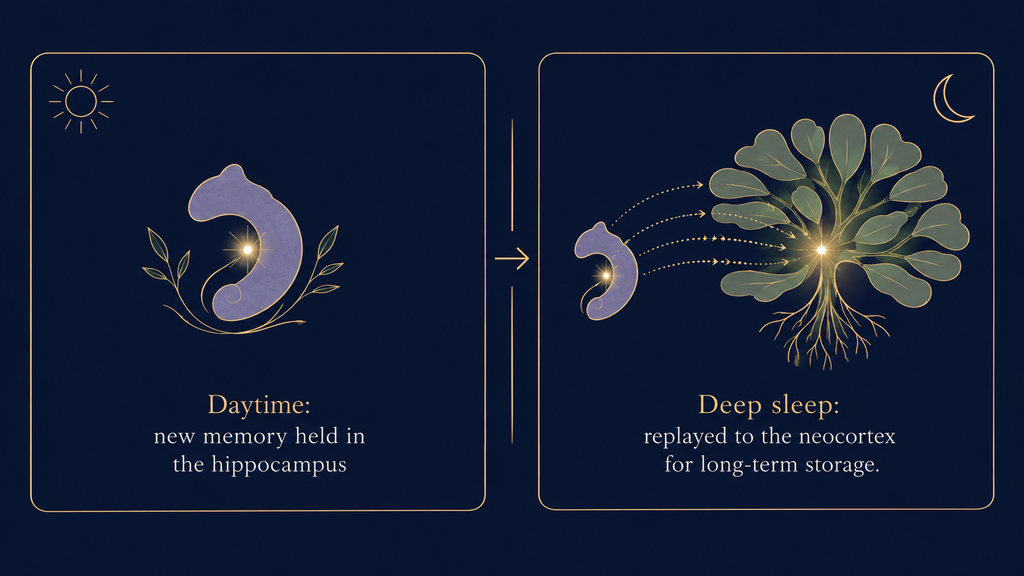
This process mainly applies to declarative memory — facts, names, the events of your day. REM sleep, later in the night, benefits procedural and emotional memory more than declarative memory — skills, habits, the emotional tone of an experience. That’s one more reason both stages matter, not just deep sleep alone.
There’s a practical takeaway here. Staying up late to review notes one more time skips the step that actually makes the material stick. The information gets encoded, but without sleep afterward, it stays fragile, more likely to fade or blur once the next day’s input arrives.
For anyone paying closer attention to memory as they get older, this is worth sitting with. Consolidation isn’t something that happens to you passively in the background. It depends on a specific, structured process your brain runs every night, one that a full night of uninterrupted sleep gives more room to complete.
The Brain’s Nightly Cleanup: Sleep and the Glymphatic System
Your brain doesn’t get a break from cleanup duty just because you’re asleep. If anything, that’s when much of the work appears to happen.
Throughout the day, normal brain activity produces metabolic waste, proteins and byproducts that build up around brain cells. One system exists specifically to clear it out: the glymphatic system, a network that uses the fluid surrounding your brain to flush this waste away.
This system runs during the day too, but it ramps up substantially during deep sleep. Research in mice found that waste clearance can run twice as fast during sleep, though how closely this carries over to humans is still being studied. Among the proteins cleared this way is beta-amyloid, a compound researcher associated with cognitive decline when it builds up over time.
Here’s the reframe: sleep isn’t just rest for the brain. It’s maintenance. The deep sleep you get tonight is doing physical cleanup work that affects how your brain ages, not just how alert you feel tomorrow.
There’s a catch worth knowing about, especially past 40. The efficiency of this cleanup system appears to decline somewhat with age, at the same time deep sleep itself tends to get lighter and more fragmented. Less deep sleep, paired with a less efficient cleanup system, is one reason sleep quality tends to matter more as you get older, not less.
None of this means one bad night is doing lasting damage. It means consistent, quality sleep is one of the more direct ways to support your brain’s own maintenance system, night after night.
What Happens When Sleep Architecture Breaks Down
Not all sleep disruption looks the same, and not all of it affects your brain the same way.
Waking up several times a night, even briefly, keeps you from completing full sleep cycles. You might log eight hours in bed, but if that time is broken into short segments, you may never reach the deeper stages of each cycle — the parts doing the memory and cleanup work covered above.
Alcohol is worth flagging specifically here. It can help you fall asleep faster, but heavier drinking suppresses REM sleep, especially in the first half of the night. The result is a night that looks complete on a tracker, with a meaningfully thinner REM stage than the total hours suggest.
An inconsistent schedule works against you a different way. Going to bed at wildly different times disrupts your circadian rhythm, and a disrupted circadian rhythm makes it harder for your brain to move efficiently into deep sleep once you’re actually asleep.
The stakes here go beyond feeling tired the next day. In a small NIH study of 20 adults, researchers found that a single night of sleep deprivation raised beta-amyloid levels by about 5% in brain regions tied to memory, including the hippocampus. One night didn’t cause lasting harm by itself, but it shows what’s happening at a biological level every time deep sleep gets cut short.
One rough night doesn’t undo your progress; the pattern matters more than any single night, and it’s worth noticing which part of your sleep is actually getting disrupted.
Why This Matters More After 40
Everything covered so far happens at every age. But the stakes shift as you get older, for a simple reason: the sleep stages doing this work naturally get less efficient over time.
Deep sleep tends to shorten and fragment more easily after 40. The glymphatic clearance system covered above also becomes measurably less efficient with age. Put those together, and the exact stage responsible for memory consolidation and brain cleanup is often the one already under the most pressure.
This is where cognitive reserve comes in — a concept covered in our Essential Guide to Brain Longevity. Cognitive reserve is your brain’s capacity to keep functioning well even as some underlying change accumulates. For a long time, most known contributors to it, years of education, the size of your social network were things already locked in decades ago, not something to build starting today.
Sleep may change that picture. Researchers at UC Berkeley studied older adults, split into two groups based on how much beta-amyloid, a protein tied to Alzheimer’s risk, had built up in their brains. Among participants with high beta-amyloid levels, those who got more deep sleep performed noticeably better on a memory task the next day — deep sleep appeared to buffer memory even while underlying changes were present. That same benefit didn’t show up in participants with low amyloid levels, so the effect looks specific to people already carrying more risk.
The researchers were careful to call this preliminary: the study was small (62 healthy older adults) and shows an association, so it doesn’t mean deep sleep prevents Alzheimer’s disease or that improving your sleep will protect your memory. What it does suggest is that sleep may be one of the reserve-building factors you can still act on today, at any age. You can’t go back and add years of education. You can prioritize your sleep tonight.
Protecting Your Sleep Architecture
None of this requires an elaborate system. A few consistent habits protect deep sleep and REM sleep specifically, rather than just adding hours.
Keep a consistent bedtime and wake time, even on weekends. Your circadian rhythm relies on that consistency to know when to shift you into deeper sleep stages, and irregular timing is one of the fastest ways to shortchange it.
Watch alcohol timing, not just quantity. Since alcohol suppresses REM sleep, drinking close to bedtime can quietly reshape a night’s architecture without showing up as a shorter total sleep time.
Keep your room cool and dark. Both circadian timing and the depth of slow-wave sleep respond to light and temperature cues more than most people expect.
For the full wind-down process — reducing stimulation before bed, calming an overactive nervous system, and building an evening routine that actually sticks, our companion guide walks through it step by step. The two pieces work together: that guide gets your body calm enough to fall asleep; this one is about protecting what happens once you do.
Frequently Asked Questions
What are the stages of sleep?
Sleep moves through NREM stages 1 through 3, then REM sleep, in cycles of roughly 90 minutes. Stage 3 deep, slow-wave sleep and REM sleep are the two stages most directly tied to memory and long-term brain health.
Does deep sleep or REM sleep matter more for memory?
They handle different jobs. Deep sleep is more closely tied to consolidating facts and events, while REM sleep supports procedural and emotional memory. Cutting either one short affects a different part of how memories get processed.
Can you “catch up” on lost deep sleep?
Partly. After lost sleep, the brain tends to prioritize deep sleep when you recover, but sleeping in adds total hours without guaranteeing you recapture everything you missed — sleep architecture responds more to consistency than to compensation. A regular schedule protects deep sleep better than an occasional long lie-in.
Is memory loss from poor sleep reversible?
Occasional poor sleep affecting next-day memory tends to improve once sleep normalizes. The research on long-term brain aging is less settled and still early, but there’s reason to think improving sleep going forward helps, it’s worth acting on, not writing off as unfixable.
Sleep Is Maintenance, Not Just Rest
It’s easy to think of sleep as something that happens to you passively, hours that pass while your brain waits for morning. It’s closer to the opposite. Every night, your brain runs a structured process that files away what you learned, clears out what it doesn’t need, and handles a measurable share of the maintenance that shapes how well it ages.
That reframes matters most after 40, when these processes naturally get harder to access. But it doesn’t mean they’re out of your control. Protecting deep sleep and REM sleep, consistently, is one of the more concrete things you can still do for long-term brain health.
This is one piece of the bigger picture in our Essential Guide to Brain Longevity. Next in this series: how chronic stress and cortisol affect the same cognitive reserve this article introduced.