


Chronic stress affects more than your mood. Research suggests it can weaken cognitive reserve, the brain’s long-term buffer against age-related decline. Here’s the mechanism, the warning signs, and what helps protect it.
The link between cortisol and cognitive reserve is more direct than most people assume. Chronic stress may do more than strain the brain in the moment: it appears to wear down cognitive reserve, the built-up capacity that helps protect long-term function despite age-related change. Researchers at the Karolinska Institutet found a closely related pattern: among patients at a memory clinic, higher cortisol was linked to a weaker protective benefit from cognitive reserve.
Most people file stress under mood: something to manage so the day feels less overwhelming. But chronic stress also reaches the hippocampus, the brain region heavily involved in memory consolidation.
This is the next layer of the approach we laid out in our brain longevity guide, applied specifically to the brain rather than the nervous system broadly: you may get sleep, nutrition, and mental engagement right and still lose ground if chronic stress goes unaddressed.
💛 Gentle Medical Disclaimer This article is for educational purposes only and isn’t medical advice. If you’re experiencing memory changes, persistent brain fog, or stress that’s affecting daily functioning, consult a qualified healthcare professional.
Table of Contents
What Chronic Stress Actually Does to the Brain
Most wellness content treats stress as something to simply calm down from. That’s useful advice, but it skips the mechanism, what’s actually happening inside the brain while the stress response runs.
The Cortisol-Hippocampus Connection
When the brain perceives a threat, real or not, the hypothalamic-pituitary-adrenal (HPA) axis releases cortisol to help the body respond. In short bursts, that’s exactly what cortisol is supposed to do. The hippocampus, the brain region most involved in forming new memories, is rich in cortisol receptors, which is part of why it’s one of the brain regions most sensitive to how much cortisol is circulating, and for how long.
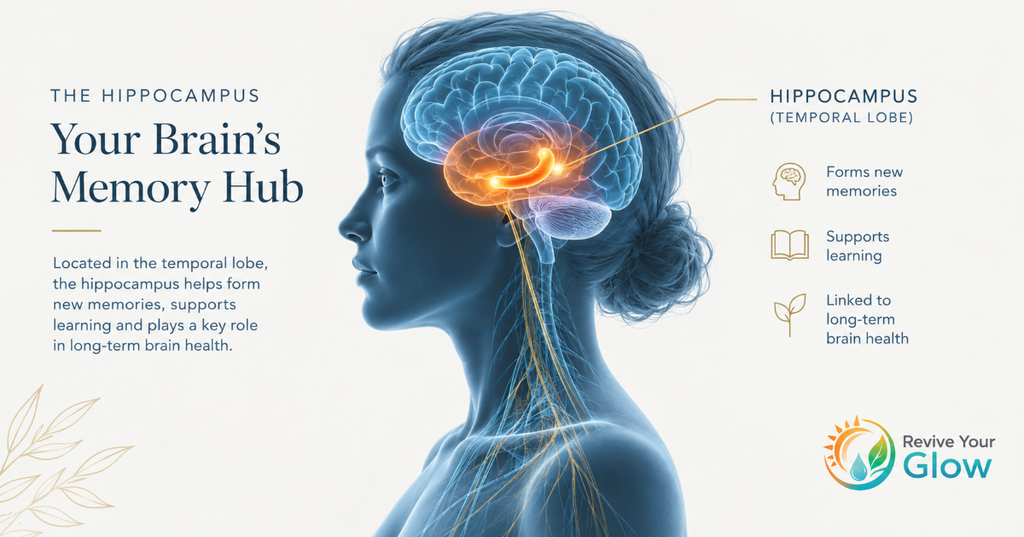
Sustained exposure is where the risk shows up. In a multi-year study of older adults, those with continuously elevated cortisol over three to six years performed worse on memory testing and had a measurably smaller hippocampus than peers with lower cortisol. In other words, the hippocampus may be shaped by long-term exposure, not just strained by a stressful season.
Acute vs. Chronic Stress
This is also where nuance matters, because not all cortisol exposure works against you. A neuroimaging study on cortisol found that a short-term rise in cortisol can actually sharpen memory encoding for emotionally significant information which tracks with ordinary experience: a genuinely stressful moment is often one you remember vividly.
The effects follow a different timeline. What seems to matter is the stress response running on repeat for months or years without enough recovery in between, not the response itself. One demanding week isn’t rewriting your brain’s structure. A demanding decade with no real recovery built in is a different question.
That distinction matters for brain health: the concern isn’t stress itself, but stress that never fully resolves.
Cortisol and Cognitive Reserve: Your Brain’s Buffer and What Drains It
The hippocampus is only part of the picture. The brain also carries a built-up buffer against age-related decline, and chronic stress may actively draw it down.
How Reserve Gets Built
Researchers call this buffer cognitive reserve: the brain’s capacity to keep functioning well even as some underlying change accumulates. The brain longevity guide covers how it’s built in more depth, but the short version is that it accumulates over a lifetime, through education, mentally engaging work, and staying socially and cognitively active. Think of it as a cushion: the bigger it is, the more change the brain can absorb before function visibly declines.
The Karolinska Finding
Here’s the part that connects reserve back to stress. The Karolinska team examined 113 patients at a memory clinic, looking at their cognitive reserve, cortisol levels, and markers linked to Alzheimer’s disease. As expected, greater cognitive reserve was associated with better cognitive performance. But once cortisol entered the picture, that protective association weakened. The reduction appeared with physiological stress (measured cortisol), not self-reported stress.
That’s a different finding than “stress is bad for memory.” It suggests chronic stress may dull the protection reserve is meant to provide, even in someone who has done everything right: the demanding career, the lifelong learning, the full social calendar. It’s a single, relatively small study of people already attending a memory clinic, and it shows an association, not proof of cause. But it points in a direction worth taking seriously.
Signs It’s Your Stress, Not Just Your Memory
Not every forgotten appointment or lost train of thought points to a brain problem. Often, it’s simpler than that: you’re carrying more cognitive load than your brain can file away cleanly, and stress is the thing doing the crowding.
A few patterns can suggest that stress, rather than memory loss itself, is the driver:
- Forgetting things you’d normally catch easily, but only during a demanding stretch, not as a steady decline
- Trouble concentrating or holding a thought in mind, which points more to attention underload than to memory itself
- Symptoms that ease up noticeably once the stressful period passes, rather than staying flat or getting worse
Brain fog itself has several possible causes, and stress is only one of them, which is exactly why the pattern matters more than the symptom on its own.
The distinction that actually matters, the one worth bringing to a doctor, is a change that’s sudden, progressive, or that interferes with daily functioning regardless of how stressful or calm life currently is. That’s a different situation than stress-driven forgetfulness, and it deserves a different response than a better stress-management routine.

Protecting Cognitive Reserve from Chronic Stress
None of this means chronic stress is unstoppable, or that its effects are locked in once they start. Protecting reserve works on two fronts: calming the stress response itself and continuing to build reserve.
Daily Regulation
The actual mechanics of regulating a stressed nervous system—breathwork, grounding, and rebuilding a sense of safety in the body form the necessary foundation here rather than a separate exercise. Regulate first, and the brain-specific habits below have a stable environment to build upon.
Reserve-Building Habits Specific to Brain Longevity
Beyond calming the stress response, certain habits appear to build cognitive reserve directly, independent of how calm you currently feel:
- Novelty, not just repetition. A new skill, route, or hobby challenges the brain differently than a familiar routine does, however pleasant that routine is.
- Genuinely engaging work paid or not. Research on cognitive reserve points to complex, mentally demanding work as one of its contributors.
- Real social connection. Isolation is one of the pathways through which stress erodes reserve-protective behaviors in the first place, so maintaining relationships isn’t separate from brain health — it’s part of it.
- Consistency over intensity. Reserve builds over a lifetime, not a weekend, so a sustainable, moderate version of these habits beats an intense one you abandon in a month.
None of these habits cancel out chronic stress on their own. But paired with actual nervous-system regulation, they’re the closest thing to a direct answer to the Karolinska finding above: build the reserve, and protect it from what drains it, at the same time.
Frequently Asked Questions
Does Chronic Stress Cause Permanent Brain Damage?
Not necessarily. Animal research suggests that some structural changes in the hippocampus can partially reverse once chronic stress subsides, pointing to the brain’s natural capacity for recovery. For more on how long-term pressures impact health, you can review the Mayo Clinic’s guide on chronic stress. While human data on full reversibility is less definitive, lowering chronic stress remains one of the most effective steps you can take to support long-term brain health.
How Much Stress Is Too Much for My Brain?
There is no single numerical threshold. Duration appears to matter far more than short-term intensity: a brief, intense stressful season behaves very differently in the body than stress that runs on repeat without recovery. If chronic stress has become your baseline rather than an occasional spike, that is the pattern worth addressing.
Can a Stressful but Engaging Career Still Build Cognitive Reserve?
Potentially both at once. Mentally demanding work is a recognized contributor to building cognitive reserve, but it does not automatically neutralize cortisol’s effects if the job is also chronically unmanageable. A demanding career can sharpen your cognitive resilience while ongoing stress works against it. Nervous system regulation matters just as much in a high-powered job as it does anywhere else.
Does Meditation or Stress Management Actually Protect Cognitive Reserve?
That specific causal link hasn’t been directly tested in large-scale clinical trials yet. However, the authors of the Karolinska study note that effective stress management logically belongs in dementia-prevention efforts, as lowering chronic stress helps ease the physiological drain on your brain’s protective buffer.
Is Testing My Cortisol Levels Worth It?
For most people, a single lab test offers very limited insight. Cortisol naturally fluctuates throughout the day in response to daily events, making a standalone measurement hard to interpret. Most research tracks cortisol patterns over extended periods rather than relying on a single reading. If you are worried about the physical toll of chronic stress, a broader conversation with a healthcare provider will yield much more actionable guidance than a standalone test.
Reserve Isn’t a One-Time Investment
It’s easy to think of cognitive reserve as something you build once and then carry with you, a bank of resilience that just works in the background from here on out. The research above suggests it’s more conditional than that: reserve may be only as protective as the conditions around it, chronic stress included.
That’s the core throughline across our broader brain health series: regulate first, optimize second. While foundational habits and proper sleep architecture support memory consolidation, chronic stress operates as a distinct variable that directly drains cognitive reserve.
Next in this series: How targeted nutrition shapes and protects that very same cognitive reserve.