


Understanding the difference between discomfort and danger in your body is one of the most important skills in nervous system awareness. When you can recognize what your body is signaling, you stop spiraling into fear and start responding from clarity, groundedness, and self-trust. This article walks you through a simple framework to help you tell the difference.
Safety Note: This article is for educational purposes only and is not a substitute for medical advice. For medical concerns, consult qualified healthcare professionals and trusted health resources such as the National Institutes of Health (NIH). If you have symptoms that suggest a medical emergency—such as chest pain, fainting, signs of stroke, or severe shortness of breath—please call 911 (or your local emergency number) immediately.
In This Guide
“I Want to Trust My Body—But Everything Feels Like a Red Flag”
You slow down for a moment. Maybe you try a short walk, a few gentle stretches, or even just a quiet sit in the sun. And then your body pipes up.
A flutter in your chest. A wave of fatigue. A tightness you didn’t notice before.
And instead of feeling like data, it feels like a siren.
This is one of the most disorienting parts of recovering from burnout, chronic stress, or trauma: your body is talking, but you’ve lost the translation guide. You don’t know if what you’re feeling is a signal to slow down, a signal to stop, or your nervous system crying wolf.
You’ve probably been told to “push through.” Maybe you pushed through so many times that you stopped listening altogether—until your body got loud enough that you couldn’t ignore it anymore.
That’s not weakness. That’s what happens when we’ve been trained to override our own signals.
The good news: you can learn to read them again. Not perfectly. Not all at once. But enough to feel less afraid of what your body is trying to tell you. We’re going to walk through a simple, gentle framework—discomfort vs. danger in your body—so that you can start to sort sensation from threat and get back to living with a little less fear.
Why Your Body Might Sound “Too Loud” Right Now
Here’s something important to understand: if your body’s alarm system feels hypersensitive, that doesn’t mean it’s broken.
It means it’s been doing its job—maybe for a very long time.
After chronic stress, burnout, or trauma, the nervous system recalibrates toward protection. It lowers the threshold for what counts as “danger.” Sensations that used to feel neutral—a faster heartbeat during a flight of stairs, a wave of emotion during a hard conversation, fatigue after a busy day—can start registering as threatening. This is sometimes called hypervigilance, and it’s a completely logical response to having been overwhelmed, dismissed, or pushed past your limits repeatedly.
If you’re curious about body-based approaches to healing, Harvard Health provides a helpful introduction to somatic therapy.
Your alarm system isn’t broken. It’s been protecting you.
The challenge is that an alarm system calibrated for survival doesn’t always know when the storm has passed. So, it keeps scanning. It keeps flagging. And you keep bracing.
This is also why somatic awareness—the practice of tuning into your body—can feel terrifying at first, not soothing. Researchers often refer to this internal sensing ability as interoception. Learn more from the Neurodiversity Education Academy’s overview of interoception. When you start listening, you hear a lot. And without a framework, that can feel worse before it feels better. If your body often feels wired, tired, or strangely numb even when you’re trying your best, this deeper look at why your nervous system can stay stuck in survival mode can help you understand what’s happening beneath the surface.
If movement has started to feel unsafe or confusing, this might help explain why: Why Movement Can Feel Unsafe After Burnout, Trauma, or Chronic Stress. That piece explores the nervous system roots of this experience in depth—and it might make a lot of your body’s behavior suddenly make sense.
The work we’re doing here is the next layer: learning to tell the difference between a sensation that’s asking for your attention and one that’s asking for your respect.
What Discomfort Often Feels Like
Discomfort is not the enemy. It’s often just a signal that something is new, effortful, or unfamiliar—not necessarily harmful.
If you’re curious about how your thoughts and physiology shape these sensations, this guide to the mind–body connection can help you understand why discomfort sometimes feels louder than it is.
Think of discomfort as the feeling of your body adjusting. It’s the stretch at the edge of your range. It’s the emotional wobble when something long-buried surfaces. It’s the tiredness that follows genuine rest, because your body finally felt safe enough to exhale.
Common forms of discomfort you might encounter:
- Mild muscle fatigue or a “worked” feeling after gentle movement
- Breathlessness during light exertion that eases when you slow down
- Emotional waves—sadness, grief, or tears—that arise without an obvious trigger
- Anxiety or nervousness in new situations (social, physical, or environmental)
- A buzzing or restless energy that isn’t painful but is hard to settle
- Temporary dizziness when standing up quickly, especially if you’ve been sedentary
The key quality of most discomfort: it responds. When you slow down, breathe, sit for a moment, drink some water, or get some reassurance—it softens. It doesn’t necessarily disappear, but it changes. It’s workable.

There’s a version of discomfort that’s sometimes called “productive” the kind that tells you you’re building capacity, releasing something held, or doing something meaningful. But this isn’t a performance metric. We’re not trying to maximize discomfort. We’re simply recognizing that not every sensation that feels intense is a signal to stop.
What we want to watch for is the difference between intensity that’s tolerable and shifting versus intensity that’s escalating or includes new, alarming elements. That’s where the next section comes in.
One more thing worth naming: “too much, too fast” is real. Discomfort that tips into overwhelm—where you can’t think, can’t orient, can’t settle—is worth slowing down for. That’s not failure. That’s feedback.
What Danger Feels Like (And Why It Deserves Respect)
Danger signals are different. They tend to persist, intensify, or come with systemic companions—the kinds of signs that suggest your body may need more than a breath and a slower pace.
We’re not here to diagnose anything. But we can name the kinds of sensations that deserve professional attention, not willpower.
Signs worth pausing and taking seriously:
- Chest pain, tightness, or pressure—especially if new, spreading, or accompanied by arm, jaw, or shoulder discomfort
- Shortness of breath that doesn’t ease with rest or that escalates unexpectedly
- Sudden, severe dizziness or loss of balance (not just “head rush” from standing)
- Heart palpitations that feel rapid, irregular, or come with lightheadedness
- Numbness or tingling in face, arm, or leg—especially on one side
- Visual changes: blurred vision, tunnel vision, sudden loss of vision
- Confusion, slurred speech, or sudden difficulty finding words
- Pain that is sharp, localized, worsening, or unusual compared to anything you’ve felt before
- Fainting or near-fainting
- Symptoms that are new, that you haven’t experienced before, and that don’t respond to rest
The pattern with danger is that it tends to escalate rather than ease. It often includes more than one symptom at once. And it frequently shows up somewhere in your body that feels genuinely alarming—not just unfamiliar.
When in doubt, get support. There is no version of this framework where you “get points” for pushing through something that might need medical care. You can always check in with a doctor, a nurse line, or a trusted healthcare provider. Seeking reassurance is not overreacting. Your body communicating urgently is not your nervous system being dramatic. It’s worth listening to.
Understanding Discomfort and Danger in Your Body
Learning to recognize discomfort and danger in your body helps you understand what your nervous system is trying to communicate before it escalates into overwhelm.
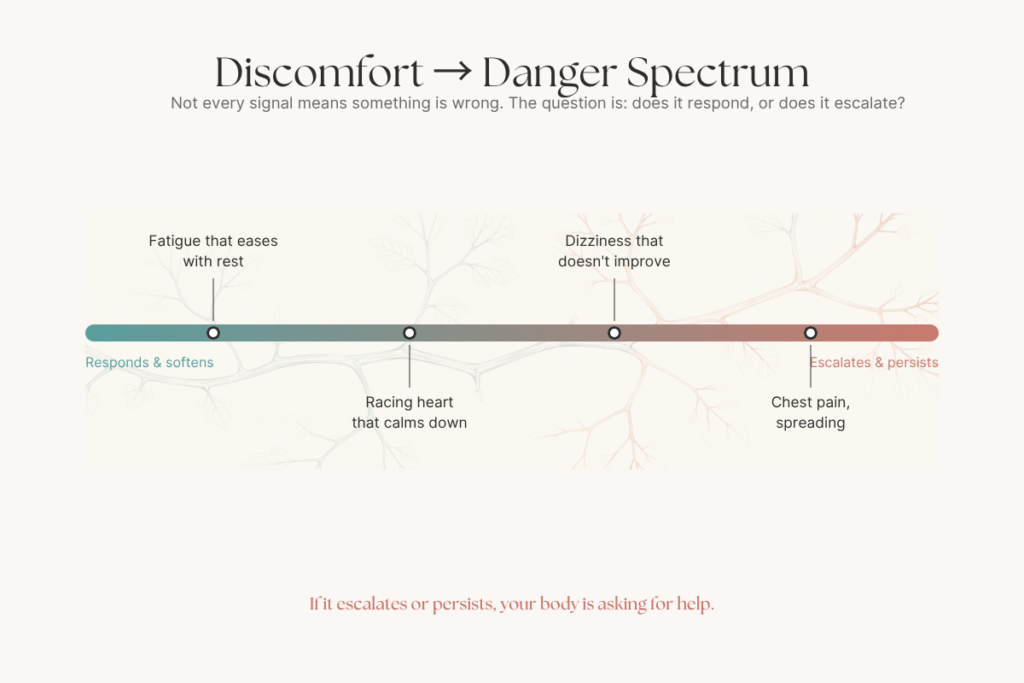
Learning to map discomfort and danger in your body builds long‑term somatic confidence and self‑trust.
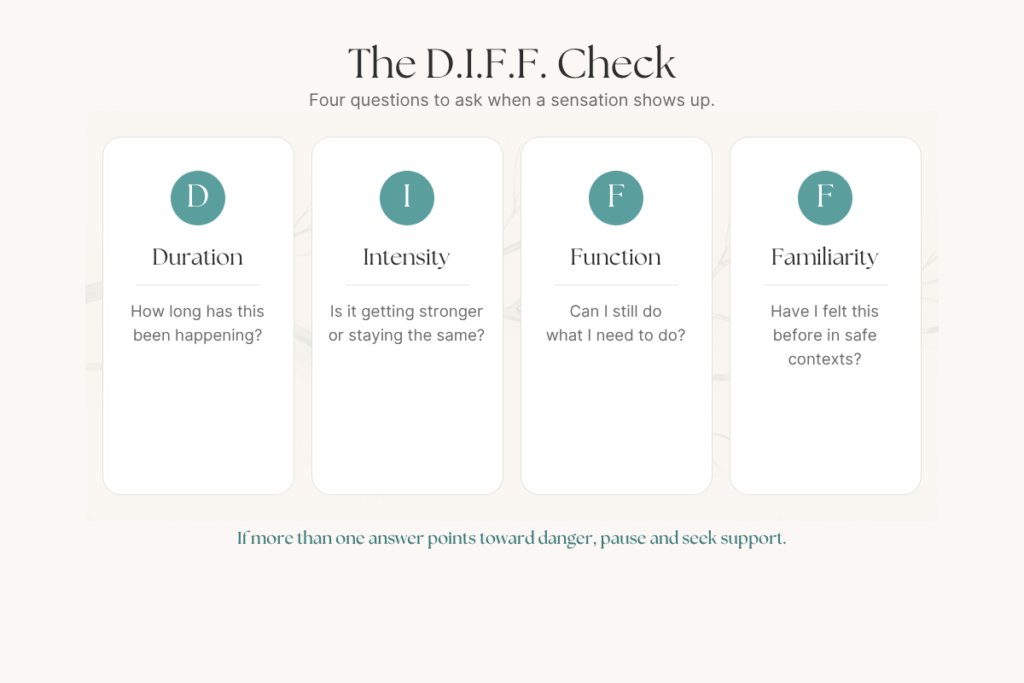
The Core Framework: The D.I.F.F. Check
When a sensation arises and you genuinely can’t tell if it’s discomfort or danger, run it through the D.I.F.F. Check—a Revive Your Glow framework designed for burnout recovery and nervous-system-aware body trust.
When you can recognize discomfort and danger in your body, you stop spiraling and start grounding.
Protective Note: The D.I.F.F. Check is a practical body-awareness framework developed by Revive Your Glow that integrates commonly recognized principles of symptom observation, nervous-system awareness, and self-reflection. It is not a medical diagnostic tool. It is meant to support reflection and self-trust—not to replace professional medical care, emergency support, or your own judgment when something feels genuinely alarming.
D — Duration
Does it settle, soften, or spike over time?
Guiding questions:
- Has this sensation been here for a few seconds, a few minutes, or longer?
- When I pause, breathe, or change what I’m doing—does it shift?
- Is this something that comes and goes, or is it constant and building?
What this tells you: Most discomfort is temporary and responsive. A tight chest from anxiety often loosens when you exhale slowly, change your environment, or have a reassuring thought. A tight chest that stays tight—or gets tighter—over 5–10 minutes without responding to rest is worth paying more attention to. Duration isn’t a perfect ruler. But change over time is one of the most useful pieces of information your body can give you.
I — Intensity
Is it tolerable and stable, or overwhelming and accelerating?
Guiding questions:
- On a scale that only you know—is this manageable?
- Is this feeling about the same as when it started, or is it building?
- Does it feel like something I can breathe through, or is it taking over?
What this tells you: Intense doesn’t automatically mean dangerous. Emotions can feel overwhelming without being harmful. Exercise can feel breathless without being dangerous. But accelerating intensity, especially when it crosses into “I can’t function”—is a cue to stop, not push through. If pain, breathlessness, or another sensation keeps climbing without relief, that’s your signal to seek support.
F — Function
Can you still speak clearly, orient yourself, walk normally, and think straight?
Guiding questions:
- Can I look around and recognize where I am?
- Can I speak in full sentences right now?
- Are my hands, legs, and movements working the way they usually do?
What this tells you: This is one of the most grounding checks you can do. If you’re disoriented, slurring words, unable to walk steadily, or having trouble forming thoughts, those are signs that your nervous system or body may be in genuine distress, not just discomfort. Discomfort is generally functional. Danger often impairs function.
F — Familiarity
Is this a known, expected sensation—or something brand new and alarming?
Guiding questions:
- Have I felt this before in a similar context?
- Does this feel like something I recognize from my body’s history?
- Is there anything about this that feels genuinely new or alarming—not just intense?
What this tells you: Familiarity doesn’t mean “ignore it.” But context matters. If you know that your legs shake when you’re nervous, that’s familiar discomfort. If you suddenly have no feeling in one leg when nothing like that has happened before—that’s unfamiliar, and worth attending to immediately.
The D.I.F.F. Check is designed to help you distinguish discomfort and danger in your body in real time.
After my cardiac arrest in 2023, I spent a long time avoiding physical activity. For about a year, I barely exercised at all. Every sensation in my body felt loaded with meaning. A faster heartbeat, heavier breathing, or tired legs could immediately trigger fear.
When I finally decided to try running again, I started with a very short distance. Within minutes, my heart rate increased and my breathing became heavier. For a moment, I felt the familiar wave of anxiety that asked, “What if something is wrong?” The interesting thing is that I didn’t have the D.I.F.F. Check back then. I only recognized these patterns later while writing this article.
Looking back, I can see that Familiarity was quietly helping me even though I didn’t have a name for it yet. I remembered what physical activity felt like before my cardiac arrest. My heart had always beaten faster during exercise. My breathing had always changed when I pushed myself. The sensations felt intense because I had been inactive for so long, but they weren’t completely new.
In hindsight, I was instinctively asking a Familiarity question: “Have I experienced something like this before?” Combined with the other parts of the framework—Duration, Intensity, and Function, I can now see why that experience was so important. What initially felt alarming was actually a familiar physical response returning after a long absence.
That experience taught me something I didn’t fully understand at the time: sometimes what feels scary isn’t dangerous. Sometimes it’s simply a sensation you’ve known before, showing up in a body you’re still learning to trust again.
If You Still Can’t Tell: A Gentle Decision Tree
Sometimes the D.I.F.F. Check helps, and you still can’t quite land on an answer. That’s okay. Here’s a step-by-step path that doesn’t require certainty—just gentleness.
Step 1: Pause and orient. Stop what you’re doing. Look around the room. Name three things you can see. Feel your feet on the floor. This isn’t a distraction trick—it’s a way of returning your nervous system to the present moment so you can assess more clearly.
If you need simple ways to steady your system while you’re sorting through sensations, these somatic grounding techniques for stress and overwhelm can support you while you pause and orient.
Step 2: Breathe slowly. One slow inhale, one slow exhale. Not forced, not dramatic. Just enough to signal to your body that it’s not in a sprint.
If you want a simple way to support your system during these moments, this breathwork guide explains how intentional breathing can calm your nervous system without forcing anything.
Step 3: Reduce intensity by 30–50%. If you are moving, slow down. If you are sitting with a heavy emotion, soften your gaze or shift position. Give your body a smaller dose of what it’s responding to.
Step 4: Add support. Sit down. Drink water. Text a friend. Step outside for a moment of fresh air. Support doesn’t have to be dramatic—it just has to be something.
Step 5: Re-check with D.I.F.F. After a few minutes: Is it easing? Staying the same? Escalating?
- Easing → likely discomfort. Proceed gently.
- Same → rest more, monitor, don’t push.
- Escalating or scary → seek professional guidance. Call a nurse line. Go to urgent care. If symptoms feel like a medical emergency, call 911.
And one thing we’ll say without apology:
You don’t get extra points for pushing through.

Micro-Practice: “Two Minutes of Body Trust”
This is not a test. There’s no right answer. It’s simply an invitation to listen.
Find a comfortable seat—chair, floor, wherever feels safe. Let your hands rest in your lap. Take one easy breath.
Set a gentle timer for two minutes.
During that time, just notice. Notice what’s happening in your body right now. Where is there tension? Where is there ease? Is there warmth somewhere, or coolness? Any sensation of buzzing, heaviness, lightness?
You don’t have to interpret it. You don’t have to fix it or name it correctly. You’re simply showing your body that you’re willing to pay attention—without judgment, without bracing, without rushing to do something about what you find.
When the timer ends, notice one thing that felt neutral or okay. Just one.
That’s it. That’s the practice.
Over time, this kind of gentle noticing starts to rebuild the relationship. Your body begins to learn: when I signal, I’m heard—and it’s safe to keep talking.
If you want small, daily habits that reinforce this sense of safety and clarity, these neurowellness practices for a calmer, clearer you pair beautifully with the D.I.F.F. Check.
You’re Learning a Language
Sensations are not verdicts. They’re data points.
And if you’re ready to explore how your body actually shifts out of survival mode, this beginner-friendly guide to nervous system regulation can help you understand what creates internal safety.
A racing heart isn’t automatically danger. Shaky legs aren’t automatically a crisis. A wave of emotion isn’t automatically a sign that something is wrong. These are pieces of information—your body’s way of communicating something that deserves your attention, your curiosity, or in some cases, your professional support.
The D.I.F.F. Check—Duration, Intensity, Function, Familiarity—gives you a starting place. Not a diagnosis. Not a guarantee. Just a gentler way to listen, so you can respond from care instead of fear.
You’re not broken if you stop. You’re not broken if you need more time. You’re not broken if today the signals felt confusing, and you couldn’t quite sort them out.
You are, in fact, doing something remarkable: trying to hear yourself again after a long time of being told not to. That matters. The story of why we started this work at Revive Your Glow might resonate with where you are right now. Once you can start to tell discomfort from danger, the natural next question is: what does safe movement actually look like for me?
And if you want the full, grounded context for everything in this article, your complete guide to neurowellness walks you through the entire arc of nervous‑system healing — from hypervigilance to body trust to daily resilience.
Final Note
You don’t have to get this perfect. You don’t have to decode every sensation or know exactly what your body is saying in every moment. What matters is that you’re beginning to listen. Every time you pause, breathe, check in, or choose curiosity instead of fear, you’re strengthening a relationship with yourself that will support you for the rest of your life.
Understanding discomfort and danger in your body is a skill that grows slowly, quietly, and compassionately. Over time, the signals become clearer, your responses become steadier, and your nervous system begins to trust that you’re paying attention.
Keep noticing. Keep softening. Keep returning to yourself. Your body is always speaking and you’re learning how to hear it.
Frequently Asked Questions
1. Why does discomfort feel like danger after burnout or trauma?
When you’ve been through prolonged stress or trauma, your nervous system recalibrates its sensitivity threshold. What used to feel manageable—physical effort, emotional waves, even rest itself—can start triggering a stress response because your system has learned to stay on alert. This is called hypervigilance, and it’s a protective adaptation, not a personality flaw. Over time, with gentle and consistent co-regulation (cues of safety from your environment, your breath, and supportive relationships), the nervous system can begin to lower its guard. This takes time. It’s not a mindset shift, it’s a biological process, and it deserves patience.
2. What if I’m wrong and I ignore a real warning sign?
This is one of the most common fears—and it’s worth taking seriously. The D.I.F.F. Check isn’t designed to replace your instincts or medical care. It’s designed to give you a framework when you’re confused, not a reason to dismiss what your body is saying. If something feels genuinely alarming—if your gut says “this is different”—trust that. Seeking support is never a mistake. You can always check in with a healthcare provider, call a nurse line, or go to urgent care. Erring on the side of getting checked out is always the safer choice.
3. Can anxiety mimic physical danger in the body?
Yes—and this is one of the most important things to understand. Anxiety triggers a real, physiological stress response: faster heart rate, shallow breathing, chest tightness, dizziness, nausea, sweating, shaking. These are genuine physical sensations, not imagined. The challenge is that they can be nearly identical to symptoms of some medical conditions. The D.I.F.F. Check encourages you to look at broader patterns (Duration, Intensity, Function, Familiarity) rather than drawing conclusions from a single symptom alone. If anxiety-driven sensations are frequent, severe, or significantly affecting your quality of life, a therapist or physician who understands somatic experiences can be enormously helpful.
4. How do I know if it’s “just discomfort” during exercise or movement?
Many people find that discomfort during movement becomes less concerning when it responds to slowing down, resting, or changing intensity and when normal function remains intact. You can still think, speak, and orient yourself. It might be intense, but it’s not escalating beyond what feels manageable. Pain that is sharp, localized, new, or worsening is different—that deserves your attention and possibly professional evaluation. When in doubt, slow down rather than push through. Movement is only beneficial when it’s sustainable, and sustainable means listening to your body’s feedback throughout, not just when it’s screaming. Because every person and situation is different, persistent, worsening, or concerning symptoms should always be discussed with a healthcare professional.
5. What should I do if I freeze or dissociate when I feel sensations?
Freezing or dissociating, feeling foggy, numb, far away from yourself, or like you’re watching yourself from a distance—is another nervous system response, and it’s more common in trauma recovery than most people realize. If this happens when you try to check in with your body, don’t force through it. Gently orient: look around, name what you see, feel your feet on the floor. These orienting cues help bring your nervous system back to the present. If dissociation is frequent or intense, working with a somatic therapist or trauma-informed mental health professional can make a significant difference. You don’t have to navigate this alone.
6. Is it normal to feel worse when I start paying attention to my body?
Surprisingly, yes—and this catches a lot of people off guard. When you’ve been disconnected from body sensations for a long time (as a way of coping, or because life demanded it), tuning back in can feel like turning up the volume on a radio that’s been quietly playing in another room. Suddenly, it’s loud. Suddenly, there’s a lot. This doesn’t mean paying attention was a mistake. It usually means your body has been holding things quietly, waiting to be heard. Start small. Two minutes of noticing, like the micro-practice above, is enough. Let your system acclimate gradually rather than diving into long sessions of body scanning right away.
7. When should I talk to a doctor or therapist about these symptoms?
Safety Note: This article is educational, not medical advice. The following is general guidance, not a clinical recommendation.
Consider contacting a healthcare professional if you experience new, unexplained, persistent, worsening, or concerning symptoms, or if symptoms are affecting your ability to function in daily life. Talk to a therapist (ideally one who is trauma-informed or somatic-aware) if: anxiety, fear of body sensations, dissociation, or hypervigilance is significantly affecting your quality of life. You don’t have to be “sick enough” to seek care. If you believe you may be experiencing a medical emergency, contact emergency services immediately.
What Comes Next
If this article helped you breathe a little easier—if it helped you see that not every uncomfortable sensation is a sign of danger, there’s an important next step.
Many of us don’t just lose trust in our bodies. We lose trust in ourselves. We start monitoring, optimizing, fixing, tracking, and correcting every sensation in the hope that we’ll finally feel safe.
But sometimes the constant pursuit of wellness becomes its own source of stress.
Read next: Why I Stopped Wellness Optimization
It’s an honest reflection on the moment I realized that healing wasn’t going to come from perfect routines, perfect habits, or perfect self-improvement. Sometimes the path back to yourself begins when you stop treating your life like a problem to solve.
Come read it when you’re ready.