


If you’ve ever survived burnout, chronic stress, trauma, or a major health event like a cardiac arrest, you’ve probably experienced a confusing paradox:
Everyone tells you that movement is good for you.
Your doctors encourage exercise. Friends suggest walking. Wellness experts remind you that movement supports heart health, mood, energy, and longevity.
Yet the moment your heart rate rises, your breathing deepens, or sweat appears, your body sounds the alarm.
I know this feeling intimately.
After receiving an AICD implant following a cardiac arrest, I found myself trapped between two realities. On one hand, I knew movement was essential for recovery. On the other, every sensation associated with exercise felt dangerous. A racing heart no longer felt like fitness. It felt like a threat. Every workout felt less like health promotion and more like playing Russian roulette with my heart. (You can read more about my recovery journey in My Wellness Reset Story).
If this sounds familiar, you’re not broken, weak, or lazy.
You may be experiencing kinesiophobia, also known as the fear of movement.
In this guide, you’ll learn what kinesiophobia is, why it develops, how it affects recovery, and most importantly, how to begin rebuilding trust between your body, nervous system, and movement.
Explore the Topics
What Is Kinesiophobia?
Kinesiophobia is an excessive fear of physical movement caused by the belief that movement may lead to injury, pain, illness, symptom flare-ups, or physical harm.
While the term is often discussed in chronic pain research, the reality is broader.
Kinesiophobia can develop after:
- Burnout
- Chronic stress
- Trauma
- Long-term illness
- Surgery
- Cardiac events
- Panic attacks
- Nervous system dysregulation
In simple terms:
Your brain begins associating movement with danger instead of safety.
This creates a powerful psychological barrier to exercise, even when movement would support healing.
Research suggests that fear of movement is present in approximately 50% to 70% of people experiencing persistent pain, making it a significant factor in rehabilitation outcomes.
Why Does Movement Feel Dangerous?
Your Body May Be Protecting You
Many people assume their fear is irrational.
Often, it isn’t.
Your nervous system developed this response for a reason.
For example:
- A panic attack caused a rapid heartbeat.
- A burnout crash followed months of overexertion.
- A cardiac emergency created fear around physical sensations.
- Trauma taught the body to remain hypervigilant.
The brain learned:
Elevated heart rate = danger.
Heavy breathing = danger.
Fatigue = danger.
So, when exercise recreates those sensations, the body reacts automatically.
The Brain Prioritizes Survival Over Logic
You may logically know that walking around the block is safe.
But fear doesn’t originate from logic.
Fear originates from your body’s threat-detection systems.
According to nervous system research, humans continuously scan for cues of safety or danger through both conscious and unconscious processes. When safety feels absent, protective responses activate automatically.
That’s why willpower alone often fails.
The body must feel safe before it fully participates.
Common Signs of Fear of Movement
Many people don’t realize they’re dealing with kinesiophobia.
You may recognize yourself in these patterns:
Physical Signs
- Avoiding exercise entirely
- Monitoring your heart rate obsessively
- Fear of sweating
- Fear of breathlessness
- Increased tension before movement
Emotional Signs
- Anxiety before workouts
- Guilt for not exercising
- Frustration with recovery
- Fear of symptom flare-ups
Behavioral Signs
- Constantly delaying exercise
- Quitting programs early
- Choosing inactivity despite wanting to move
- Seeking reassurance repeatedly
The issue is not laziness. The issue is perceived danger. Many of these behaviors are consistent with constructs measured by the Tampa Scale for Kinesiophobia, one of the most widely used tools for assessing fear of movement and activity-related injury.
The Nervous System’s Role in Kinesiophobia
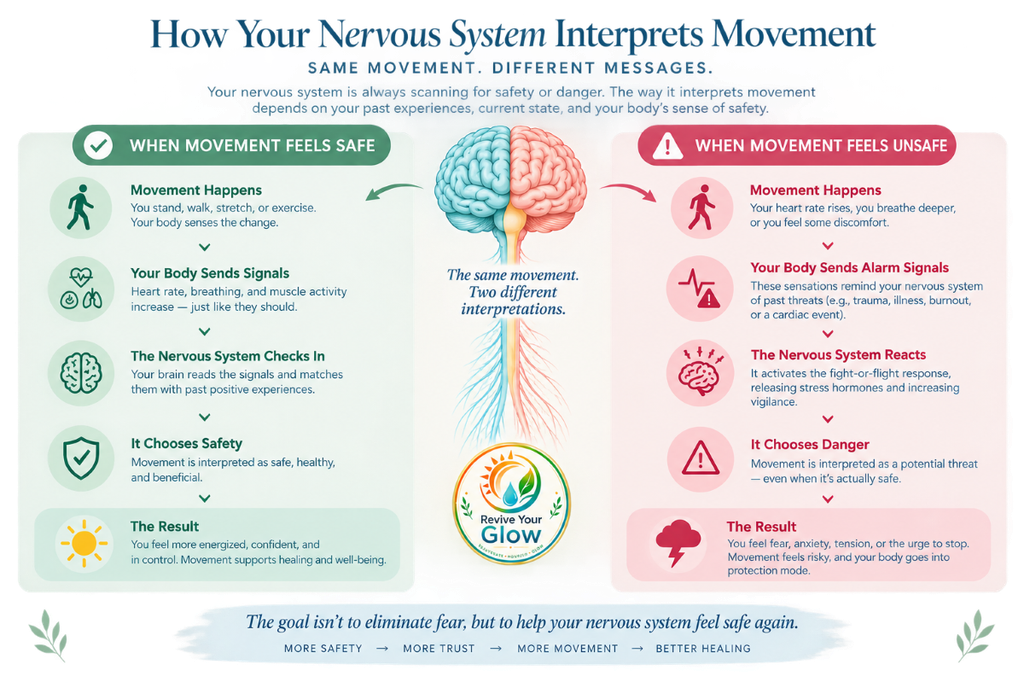
When burnout becomes chronic, the nervous system may begin interpreting physical exertion as a potential threat rather than a source of energy. This shift can make previously enjoyable forms of movement feel unsafe or overwhelming.
To explore this process in greater depth, read our guide:
👉 [Why Movement Feels Unsafe After Burnout, Trauma, or Chronic Stress]
The key insight:
Your body isn’t resisting movement.
Your body is resisting perceived danger.
Trauma Changes How the Body Interprets Sensations
After trauma, the nervous system may become highly sensitive.
Normal exercise sensations can be mistaken for emergency signals:
- Faster heartbeat
- Increased body temperature
- Muscle fatigue
- Adrenaline release
Instead of interpreting these sensations as healthy exertion, the body experiences them as warning signs.
This is one reason trauma-informed movement approaches are often more effective than “push through it” fitness advice.
How Fear of Movement Keeps You Stuck
Kinesiophobia often creates a self-reinforcing cycle.
The Fear-Avoidance Loop
- Movement feels threatening.
- Movement is avoided.
- Physical capacity declines.
- Everyday activity feels harder.
- Fear increases.
- Avoidance grows.
Researchers have identified fear-avoidance patterns as major contributors to disability and reduced function.
The goal isn’t forcing movement.
The goal is restoring safety.
A Gentle Framework for Overcoming Kinesiophobia
Step 1: Stop Measuring Success by Intensity
Many people assume exercise must feel intense to be beneficial.
That’s simply not true.
The World Health Organization notes that physical activity includes all forms of movement, not just vigorous exercise. Regular movement supports cardiovascular, mental, and overall health.
Start smaller than your ego wants.
Examples:
- Two-minute walk
- Gentle stretching
- Chair yoga
- Slow mobility practice
Consistency matters more than intensity.
Step 2: Build Evidence of Safety
Each positive movement experience teaches your nervous system:
“Nothing bad happened.”
Try this micro-framework:
Notice
Observe anxiety without judgment.
Move
Engage in a tiny amount of movement.
Reflect
What actually happened?
Repeat
Build safety through repetition.
Over time, confidence grows from evidence, not motivation.
Step 3: Regulate Before You Exercise
Before movement:
- Practice slow breathing
- Use grounding techniques
- Spend time outdoors
- Listen to calming music
For additional strategies, read:
👉 [Nervous System Regulation 101: How to Shift Out of Survival Mode]
and
When the nervous system feels safer, movement usually becomes easier.
Step 4: Use Movement as Regulation, Not Performance
Ask:
“What helps me feel safer?”
Instead of:
“How hard should I work?”
Examples:
- Walking in nature
- Gentle cycling
- Restorative yoga
- Tai Chi
- Swimming
These activities often support nervous system regulation while rebuilding physical confidence.
Step 5: Celebrate Capacity, Not Calories
Track wins such as:
- Less fear before movement
- Better recovery afterward
- Increased confidence
- More consistent habits
Healing is often psychological before it becomes physical.
Can Kinesiophobia Go Away?
Yes.
For many people, kinesiophobia improves significantly when movement is reintroduced gradually and safely.
Research suggests exercise-based interventions can reduce fear of movement across multiple populations, particularly when paired with education and supportive rehabilitation strategies.
The key is progression, not pressure.
What Healing Progress Actually Looks Like
Many people expect recovery from kinesiophobia to be dramatic.
In reality, progress is often subtle at first.
You may notice:
- Less anxiety before movement
- Fewer “what if something goes wrong?” thoughts
- Greater willingness to try new activities
- Reduced need to monitor symptoms constantly
- Faster recovery after exercise
- Increased confidence in your body’s abilities
Healing rarely happens in a straight line.
Some days movement will feel easier. Other days fear may return unexpectedly.
This does not mean you’re failing.
Recovery is often measured not by the absence of fear, but by your ability to move forward despite it.
Over time, these small victories accumulate into something powerful: renewed trust in your body.

3 Movement Myths That Keep People Stuck
Myth #1: If I Feel Fear, I Should Avoid Movement
Fear does not always indicate danger.
In many cases, fear is simply the nervous system responding to past experiences rather than present threats.
Myth #2: Exercise Must Be Intense to Count
Even small amounts of movement can support physical and mental health.
A short walk, gentle stretching session, or mobility practice can provide meaningful benefits.
Myth #3: Progress Should Be Linear
Recovery often includes setbacks, fluctuations, and periods of slower growth.
These challenges are a normal part of rebuilding confidence and capacity.
FAQ
What is the difference between kinesiophobia and laziness?
Kinesiophobia is fear-based avoidance. Laziness is a lack of motivation. People with kinesiophobia often want to move but feel unsafe doing so.
Can trauma cause fear of exercise?
Yes. Trauma can alter how the nervous system interprets physical sensations, making normal exercise responses feel threatening.
Why does my heart rate trigger anxiety during exercise?
If you’ve experienced panic, burnout, or cardiac events, your brain may associate a rapid heartbeat with danger rather than exertion.
Is kinesiophobia common after burnout?
Yes. Many people recovering from burnout experience heightened nervous system sensitivity that can create fear around movement and exercise.
Should I force myself to exercise?
Usually not. Gradual, safety-focused exposure is often more effective than pushing through fear.
What is the first step to overcoming fear of movement?
Begin with very small, manageable forms of movement while focusing on building feelings of safety and trust in your body.
Next Steps
If this article resonated with you, your fear of movement isn’t the real problem.
The real issue may be that your nervous system no longer feels safe with movement.
If you’re still wondering why exercise can feel threatening even when you know it’s beneficial, explore our comprehensive guide:
👉 Why Movement Feels Unsafe After Burnout, Trauma, or Chronic Stress
And keep an eye out for our upcoming guide:
👉 Panic Attack During Workout? Why Exercise Can Trigger Anxiety or Panic Symptoms
If this article helped you, consider leaving a comment, sharing it with someone who may need it, or exploring more resources on Revive Your Glow.
Rebuilding Trust in Your Body
Recovering from burnout, trauma, chronic stress, or a major health event is not simply a physical journey. It is a relationship-building process between you and your body.
Kinesiophobia happens when the nervous system learns that movement equals danger.
Healing begins when we patiently teach it otherwise.
You do not need to become fearless overnight.
You only need enough safety to take the next small step.
And with each safe movement experience, your body gains new evidence that recovery is possible, movement can be trusted again, and vitality is still available to you.