

You finally decide to move your body again.
Maybe you’ve survived burnout. Maybe you’ve lived through a frightening medical emergency. Maybe, like me, your relationship with exercise changed forever after a cardiac event that taught you how quickly life can change.
Then it happens.
Your heart rate rises. Your breathing deepens. Your chest feels different.
And suddenly your brain sounds the alarm.
What should feel healthy begins to feel dangerous.
If you’re recovering from cardiac arrest and living with an ICD, this is the cruel paradox of recovery. Your doctors say move. Your body says danger. I’ve lived it, and I share how I got here in Revive My Glow: The Life-Changing Moment That Helped Me.
A panic attack during workout doesn’t mean you’re weak. It usually means your nervous system learned that a racing heart equals a threat. What was learned can be relearned.
This guide covers why exercise-induced anxiety happens, how to tell panic from a real warning sign, and a step-by-step way back. For the wider picture, start with Why Movement Feels Unsafe After Burnout, Trauma, or Chronic Stress.
Your Regulation Roadmap
Why Does Exercise Feel Like a Panic Attack?
One of the most frustrating aspects of exercise-induced anxiety is that the symptoms often look almost identical.
During exercise, your body naturally experiences:
- Increased heart rate
- Faster breathing
- Sweating
- Warmth in the chest
- Adrenaline release
- Muscle tension
Those same sensations commonly occur during panic attacks.
For a nervous system that has experienced trauma or medical crisis, these signals can be interpreted as danger rather than exertion.
The body recognizes the sensation before the conscious mind recognizes the context.
This is especially common among people recovering from:
- Cardiac arrest
- Heart procedures
- ICD implantation
- Long-term burnout
- Chronic illness
- Panic disorder
- PTSD or trauma
Your brain has to guess whether that’s effort or emergency.
After trauma, the guess tilts toward emergency. Research on panic describes how people learn to treat ordinary bodily arousal as dangerous, then avoid physical effort.
Your body isn’t betraying you. It’s running an old alarm on new data.
The 4-Step Panic Loop
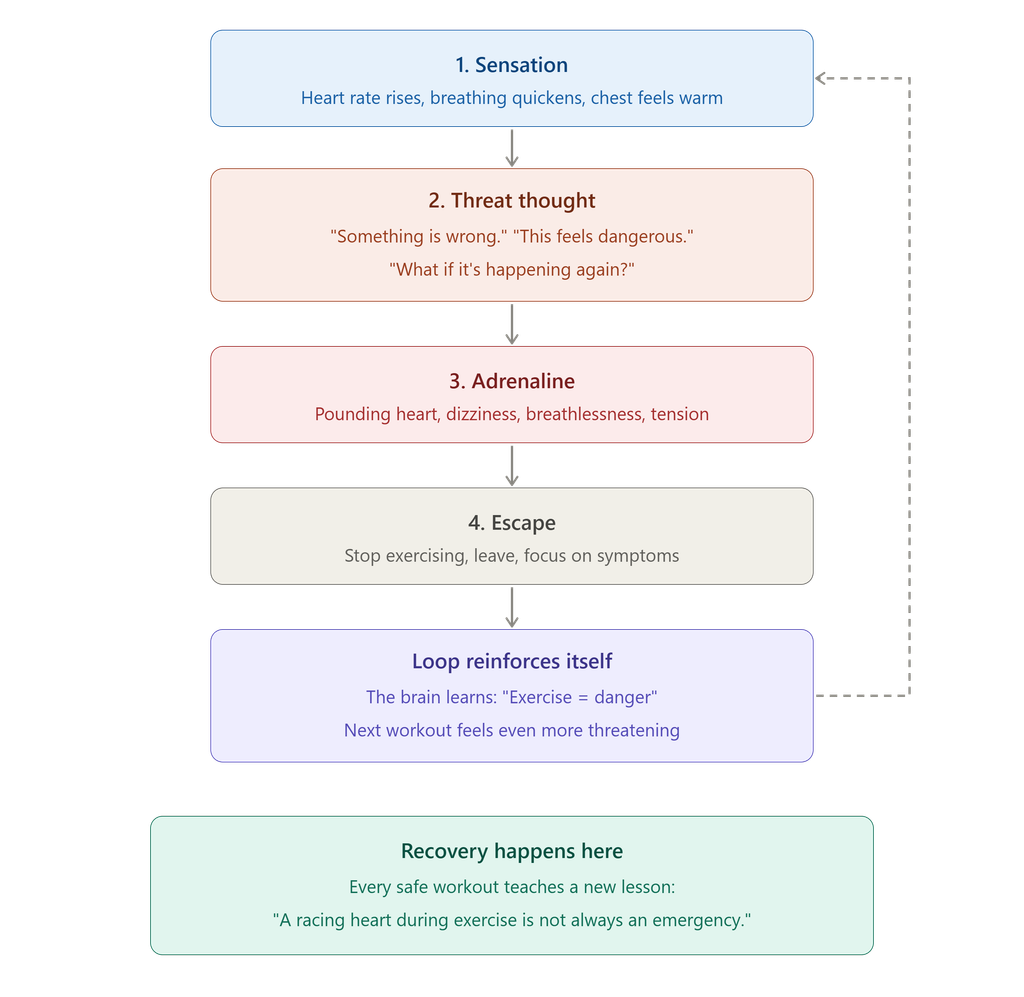
- Sensation: your heart rate rises
- Threat thought: “This is it.”
- Adrenaline: more pounding, more breathlessness
- Escape: you stop, and your brain files exercise as unsafe
Every escape strengthens the alarm. Every calm repetition teaches your brain that you’re safe. This is the same pattern behind kinesiophobia, or fear of movement.
Heart Rate Anxiety After Trauma: Why ICD Survivors Feel It Most
With an ICD, a rising pulse carries extra meaning. It can echo the day your heart stopped, or the fear of a shock.

Several months after my ICD implantation, I decided it was time to try running again. Running had been a part of my life since 2017, and over the years I had participated in numerous races. Before my cardiac arrest, lacing up my running shoes felt natural. Afterward, every step carried a new layer of uncertainty.
As I started a light jog, I instinctively kept one hand over my chest where the ICD was implanted. Even though I had healed from surgery, I worried that the repetitive impact of running might somehow shift the device or dislodge one of the leads. Rationally, I understood the device was secure, but fear doesn’t always follow logic.
Within a minute or two, my heart rate would climb, and my attention would be locked onto every heartbeat. The sensation felt completely different from the confidence I once had as a runner. Instead of focusing on pace or distance, I found myself monitoring my pulse and wondering whether the rapid increase was normal. More often than not, I would slow back down to a walk, waiting for both my heart rate and my anxiety to settle.
Looking back, I realized I wasn’t just rebuilding my fitness. I was rebuilding trust in my body. My legs were ready to run, but my nervous system was still learning that an elevated heart rate during exercise did not automatically mean danger.
That fear is common. It helps to know what the evidence says. A review of ICD studies found exercise training appears safe and wasn’t linked to more shocks. In three studies, sedentary patients were more prone to shocks than those in rehab. Read the review on PubMed.
“Safe for most” is not “safe for you” until your care team says so. Ask your electrophysiologist:
- What is my ICD’s detection rate?
- What heart rate should I stay under?
- Which symptoms mean stop?
- Should I join cardiac rehab?
The American Heart Association’s rehab guidance says psychological distress, including anxiety, deserves assessment in cardiac rehab. See the AHA scientific statement. To build the foundation, see the Neurowellness guide.
Is It Panic or a Real Cardiac Warning?
Ask this before you assume anything.
Panic often looks like: fear building alongside the sensations, tingling hands, shakiness, and a peak within minutes that eases as you slow down.
Red flags: fainting or near-fainting, crushing chest pain, a shock from your device, or symptoms that don’t settle with rest. Stop, follow your emergency plan, and call 911 or your device clinic.
When in doubt, get checked. Carefulness isn’t paranoid.
A 5-Step Plan to Exercise Without Triggering Panic
1. Get clearance and your numbers
Know your heart rate ceiling before you start. Fear shrinks when it has a boundary.
2. Start below your alarm
Try the 2-minute rule: walk two minutes at an easy pace and stop before fear rises. Ending calm teaches your brain the session was safe.
3. Lengthen your exhale
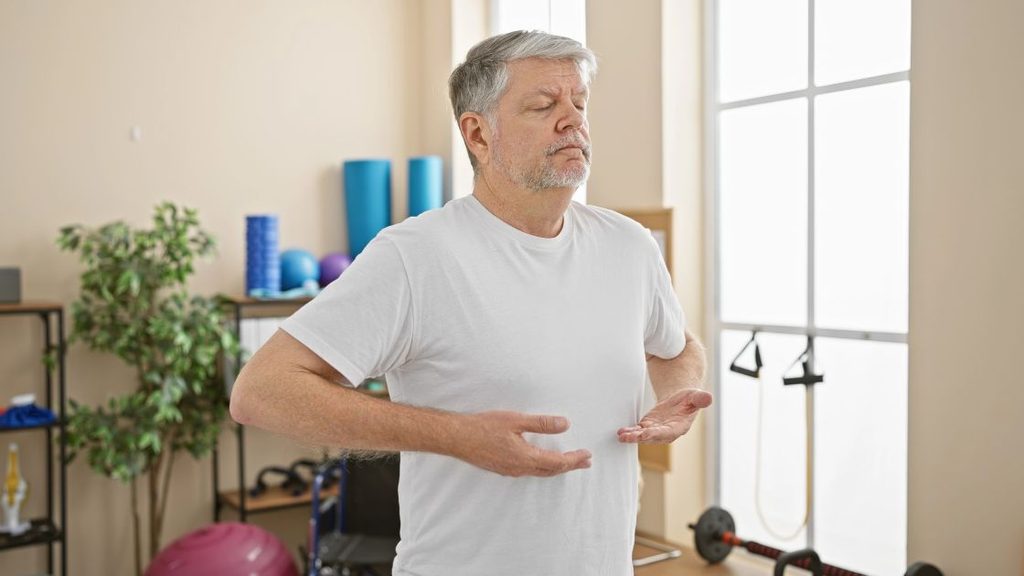
Breathe in for 4, out for 6. Do five rounds before, during pauses, and after.
4. Label it out loud
Say: “This is adrenaline. My heart is working. I’m inside my limits.”
5. Repeat, then add a little
Repeat the same easy session until it feels boring. Then add one minute. Repeated, controlled exposure to feared body sensations is a core part of panic treatment. Researchers have even studied short bouts of intense exercise as a form of interoceptive exposure, helping people learn that sensations such as a racing heart, breathlessness, and adrenaline are uncomfortable but not necessarily dangerous.
Stay within your cardiologist’s limits and use Nervous System Regulation 101 for calming skills.
Why Am I Panicking Even When Medical Tests Are Normal?
Because reassurance and regulation are different things.
Medical clearance tells you the danger may be gone.
Your nervous system may not have received that message yet.
This is why many people continue experiencing panic while exercising despite normal test results.
Recovery often involves teaching the nervous system what the medical system already knows.
FAQ
Why does working out feel like a panic attack?
Exertion and panic share the same body signals. After trauma, your brain may read them as danger.
Can exercise anxiety happen after cardiac arrest?
Yes. Heart-focused fear is common after a cardiac event and can make exertion feel threatening.
Is it safe to exercise with an ICD?
Studies suggest supervised exercise is generally safe but get your electrophysiologist’s limits first.
How do I tell panic from an arrhythmia?
You can’t always tell alone. Fainting, crushing chest pain, or a shock means stop and get help.
Can exercise-induced panic go away?
Many people improve with gradual exposure, breathing skills, and trauma-informed therapy.
Who should I see?
Your electrophysiologist, a cardiac rehab team, and a therapist who understands medical trauma.
What to Do Next
Read the full pillar guide, Why Movement Feels Unsafe After Burnout, Trauma, or Chronic Stress. And keep an eye out for the final article in this series: How to Rebuild Trust in Your Body After Burnout.
Have you felt panic mid-workout? Share your story in the comments or pass this to someone who needs it.
Learning to Feel Safe Again
Panic during exercise is a learned alarm, not proof that your heart or body has failed. After cardiac arrest, trauma, burnout, or a major health event, it’s normal for your nervous system to interpret a racing heart as a warning sign. Recovery isn’t just about rebuilding physical strength. It’s about rebuilding trust in your body’s ability to move safely again.
With medical clearance, small steps, and consistent repetition, that alarm can become quieter. Every walk, every jog, and every workout completed within your limits teaches your brain a new lesson: not every elevated heartbeat is an emergency.
Start with two minutes. Stop while you still feel safe. Repeat until your body and mind remember what your doctors already know: you’re stronger than the fear.